Nancy Mitford: Life, Books, and Why Her Novels Still Matter
Discover Nancy Mitford books, her remarkable life, famous family, sharp social satire, beloved novels, and why her writing still feels fresh to readers today.

Meet Nancy Mitford: The Wit, Family, and Books Behind the Legend
Hi Bookish Besties, There are some classic authors I admire, and then there are the ones I genuinely want to spend time with. Nancy Mitford falls firmly into the second category for me. When I pick up one of her novels, I never feel as though I’m settling in for an important classic that I’m supposed to appreciate. I feel like I’ve taken a seat beside a very funny woman who knows exactly which family stories she probably shouldn’t tell me and has decided to tell me anyway. That is the Nancy Mitford appeal in a sentence.
Her books are filled with country houses, impossible relatives, romantic disasters, social rules, class absurdities, and women doing things their families absolutely did not have in mind for them. They’re funny enough to be comfort reads, but there’s always something sharper underneath. The more I’ve learned about Nancy’s actual life—the extraordinary Mitford family, the political divisions among her sisters, her unhappy marriage, her years in France, and the love affair that never quite became what she wanted—the more interesting those warm, witty novels have become to me.
So if you’ve arrived here wondering who Nancy Mitford was, which Nancy Mitford books matter most, and why we’re still reading her, this is where I would begin.

Who Was Nancy Mitford?
Nancy Mitford was an English novelist, biographer, essayist, and one of the sharpest comic observers of upper-class British life in the twentieth century. Born in 1904, she was the eldest daughter in a family that would eventually become almost as famous for its politics, scandals, marriages, and personalities as Nancy became for her books. And that is saying something.
Nancy was the eldest of the six Mitford sisters, alongside Pamela, Diana, Unity, Jessica, and Deborah. There was also one brother, Tom. The siblings grew up in an eccentric aristocratic household with limited formal education for the girls, elaborate family jokes, private language, nicknames, fierce loyalties, and personalities strong enough to fill several novels. Which, conveniently, they eventually did.
Nancy transformed pieces of that childhood world into fiction, particularly in The Pursuit of Love and Love in a Cold Climate. She wasn’t simply copying relatives onto the page, but she understood large eccentric families from the inside, and that intimacy gives her comedy its particular warmth. She knew exactly how ridiculous families could be. She also knew how much they could hurt one another.
Growing Up in One of Britain’s Most Extraordinary Families
It is almost impossible to talk about Nancy without eventually arriving at the Mitfords. Their father, David Freeman-Mitford, later Lord Redesdale, was known within the family as Farve. Their mother, Sydney, presided over a household that was privileged but unconventional, particularly when it came to the girls’ education. The sisters spent enormous amounts of time reading, writing letters, inventing games and language, and entertaining one another.
Then adulthood arrived, and the six sisters somehow managed to scatter themselves across wildly different ideological and social worlds. Diana became involved with British fascist leader Sir Oswald Mosley. Unity became an enthusiastic supporter of Hitler and Nazi Germany. Jessica went dramatically in the opposite direction and became a communist before later establishing herself as an investigative writer in America. Deborah eventually became Duchess of Devonshire. Pamela preferred a quieter rural life. And Nancy watched all of it.
That doesn’t mean her novels should be treated as coded biographies where every fictional character corresponds neatly to one family member. I think that actually makes the books less interesting. What Nancy borrowed was something deeper: the emotional architecture.
The private jokes. The strange rules every family assumes are normal. The intense sibling bonds. The habit of turning outrageous behavior into another story to tell later. The simultaneous affection and exasperation that comes from knowing people far too well. Once I understood that, her fiction changed for me.
How Nancy Mitford Turned Family Life Into Comedy
Nancy’s great talent was not simply having excellent material. Plenty of people grow up in complicated families. Very few turn them into comedy as effortlessly as she did.
What I love about Nancy is that she rarely stops to explain why something is funny. Someone says something outrageous, another character reacts as though this is perfectly normal, and Nancy keeps moving while I’m still laughing. That lightness can make the books look simpler than they are. They aren’t.
Nancy is always watching class, money, marriage, family expectations, social performance, and the tiny hierarchies people build around themselves. She’s simply funny enough that you don’t feel as though you’ve been assigned a lecture on any of them. That combination—social observation without heaviness—is one of the reasons I keep coming back.
The Pursuit of Love Is the Nancy Mitford Book I Would Start With

If you only remember one thing from this guide, make it this: start with The Pursuit of Love. Published in 1945, the novel is narrated by Fanny Logan but revolves largely around her cousin Linda Radlett and the spectacularly eccentric Radlett family.
Linda spends much of the novel pursuing the idea of romantic love and making decisions that range from understandable to things I would strongly advise discussing with a friend first. She’s impulsive, passionate, restless, and endlessly convinced that the next version of love might finally be the right one.
What makes the novel such a comfort read for me is the family around her. The Radlett children gather in the linen cupboard. Their father, Uncle Matthew, terrifies and adores them in equal measure. Everyone has opinions. Everyone has habits. Everyone behaves as though their particular form of chaos is simply how civilized people live.
And underneath the humor there is real sadness. That balance is where Nancy is strongest. She can make me laugh at a character and then, a few pages later, make me ache for the same person.
If you want my full reading path after that, I’ve put together a separate guide on where to start with Nancy Mitford. But The Pursuit of Love is the door.
Love in a Cold Climate Is Nancy at Her Sharpest

After The Pursuit of Love, I would go directly to Love in a Cold Climate. The novel returns to Fanny’s world but focuses on Polly Hampton, a beautiful heiress whose family has extremely specific ideas about whom she should marry. Polly, inconveniently, has ideas of her own.
I think Love in a Cold Climate is where Nancy’s social satire becomes particularly delicious. Marriage, inheritance, reputation, family expectation, and class all become part of the machinery she is quietly dismantling while appearing merely to tell us a very entertaining story.
This is also where I think readers who assume Nancy writes sweet little period comedies discover the blade underneath. She notices everything. And she is absolutely judging some of it.
The Blessing Shows Another Side of Nancy

Once you’re comfortable in Nancy’s English world, The Blessing is where I would send you next. The novel turns toward an Anglo-French marriage and lets Nancy play with cultural differences, infidelity, family expectations, and the sometimes enormous gap between English and French ideas about love. It is still funny, still recognizably Nancy, but the setting and perspective are different.
That makes sense when you look at Nancy’s own life. France became central to her identity, both personally and professionally, and her fascination with French culture eventually shaped not only her fiction but her historical writing.
I like The Blessing because it reminds me that Nancy wasn’t simply the woman who fictionalized the Mitfords. Her world became much larger than the family she started with.
Don’t Tell Alfred Brings Fanny to Paris

Don’t Tell Alfred returns to Fanny later in life, when her husband unexpectedly becomes British ambassador to France. Suddenly Fanny is dealing with diplomacy, Parisian society, children, politics, social obligations, and the sort of people Nancy loved observing because they took themselves wonderfully seriously.
I wouldn’t start your Nancy Mitford reading here. But I enjoy it much more once I already know Fanny and understand Nancy’s comic rhythms. It feels like returning to someone familiar at a completely different stage of life.
Nancy’s Earlier Novels Are Worth Exploring Too
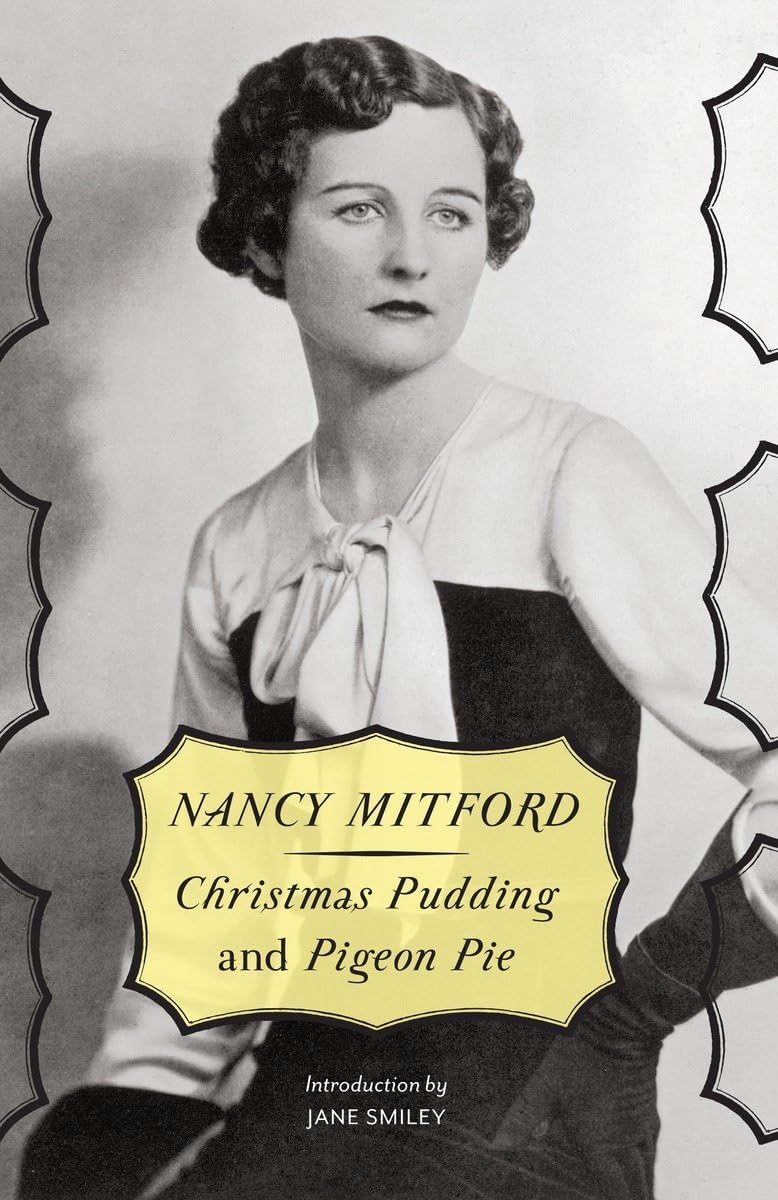
Before The Pursuit of Love made Nancy famous, she had already been writing fiction for years. Her earlier novels include Highland Fling, Christmas Pudding, Wigs on the Green, and Pigeon Pie. I think of these as books for the reader who has already fallen for Nancy and wants to see how she became the writer of The Pursuit of Love.
Christmas Pudding is particularly fun if you’re reading seasonally, although the title may give you a slightly more conventionally festive impression than the book actually delivers.
What interests me most about the earlier fiction is seeing Nancy sharpen the voice that eventually becomes so effortless. The satire is already there. The social world is already there. She’s simply learning exactly how hard she can press.
Nancy Mitford Was Also a Surprisingly Readable Historian

This is the part of Nancy’s career I think modern readers overlook most often. She didn’t only write novels. She also wrote biographies and historical works, particularly about France.
Madame de Pompadour explores the life of Louis XV’s famous mistress. Voltaire in Love focuses on Voltaire and Émilie du Châtelet. The Sun King turns to Louis XIV and Versailles, while Frederick the Great moves beyond France to the Prussian king.
What I enjoy about Nancy’s historical writing is exactly what I enjoy about her fiction: she’s interested in personality. She understands that politics and history are made by human beings who have friendships, vanities, rivalries, appetites, romantic attachments, social ambitions, and terrible judgment.
History never becomes merely a sequence of dates. There are always people in the room. And Nancy always wants to know what they’re like.
France Became Nancy Mitford’s Second Life
Nancy’s relationship with France was not simply literary. After the Second World War, she made Paris her home and later lived near Versailles. French culture, history, manners, art, and social life became deeply embedded in both her writing and her personal identity.
Her years in France were also connected with one of the central relationships of her life. Nancy fell deeply in love with French politician and diplomat Gaston Palewski. The relationship lasted in various forms for years but never gave Nancy the settled romantic partnership she wanted.
Palewski helped inspire Fabrice in The Pursuit of Love, which makes Linda’s grand romantic attachment feel different once you know something about Nancy’s own emotional life.
This is one of the things I find most moving about her. Nancy could transform disappointment into sparkle. The feelings weren’t necessarily lighter because the writing was funny. Sometimes the comedy was simply how she carried them.
Nancy’s Marriage Was Far Less Romantic Than Her Fiction
Before France became the center of her life, Nancy had married Peter Rodd. The marriage was unhappy and eventually ended in separation. Rodd was charming but unreliable, and the relationship never became the secure partnership Nancy might have wanted.
That personal history makes the way she writes marriage especially interesting to me. Nancy is never particularly sentimental about it. Her characters want romantic love desperately, but marriage itself is frequently another matter altogether.
People marry for the wrong reasons. They misunderstand what they want. They confuse passion with permanence. They discover that love does not automatically make domestic life work. That feels remarkably honest for books that are so frequently described as charming. Nancy is charming. She is not naive.
The Political Side of the Mitford Family Changed Nancy Too
It would be impossible to write a serious overview of Nancy’s life without acknowledging what happened between the sisters politically. Diana’s commitment to British fascism and Unity’s devotion to Hitler placed Nancy in a profoundly difficult position during the Second World War. Nancy opposed fascism and provided British authorities with information about Diana, describing her sister as dangerous because of her political convictions and connections.
That part of Nancy’s history fascinates me because it complicates the idea of family loyalty. This was not somebody Nancy barely knew. This was her sister. But war turned political beliefs into something much more serious than disagreements around a dinner table.
If you want the full story of how the Mitford sisters ended up scattered across fascism, Nazism, communism, aristocracy, and literature, I’ve written a separate deep dive on The Six Most Scandalous Sisters in England.
For this page, the important point is that Nancy’s fiction came from someone who understood family division much more deeply than the cozy surface of her novels might initially suggest.
What Makes Nancy Mitford’s Writing Feel So Distinctive
If I had to explain Nancy’s style without using literary terminology, I would say this: She notices people. That’s really it.
She notices the little thing someone says that reveals an enormous amount about them. She notices the rules people obey without questioning. She notices how families develop their own vocabulary. She notices what people pretend not to care about. And she doesn’t overexplain.
That confidence is a huge part of her charm. Her humor is dry rather than performative. Her satire can be sharp without turning everyone into a monster. And her narrators often occupy exactly the position I enjoy most in fiction: close enough to love the people they’re describing, but distant enough to see their nonsense. That is a difficult balance. Nancy makes it look effortless.
Family Is Really the Center of Everything
People talk about Nancy as a novelist of class, marriage, and English high society, which she certainly is. But I think family is the thread underneath nearly everything.
Her families are ridiculous because real families are ridiculous. They have nicknames nobody outside the house understands. They repeat stories. They remember childhood differently. They form alliances and grudges. They love one another while also knowing precisely which sentence will make another person furious.
That feels more universal to me than the aristocratic setting. I don’t need to have grown up in a country house to understand the feeling of realizing that something my family considers entirely ordinary would require significant explanation to an outsider. That’s why the Radletts work. They’re specific enough to feel real.
Her Romantic Heroines Aren’t Especially Sensible, and I Love Them for It
Nancy’s women also make her feel more modern to me than her classic-author label sometimes suggests. They are not particularly interested in being admirable.
Linda Radlett is perhaps the clearest example. She wants love. Then she wants another version of love. Then something changes. She is often wrong. She is sometimes selfish. She can be painfully romantic. And Nancy lets her be all of those things.
I much prefer that to a heroine carefully designed to earn my approval. Nancy understands that people don’t make choices according to the neat moral architecture of novels. They make them because they’re lonely. Or bored. Or hopeful. Or convinced this time will be different. That messiness is one reason the books still breathe.
Why Nancy Mitford Books Still Work for Me
The older I get, the more I appreciate books that are intelligent without making intelligence feel like labor. Nancy gives me that.
I can read her for class satire if that’s what I want. I can read her for the history behind the Mitford family. I can think about gender, marriage, privilege, social performance, and the changing world of the British aristocracy. Or I can sit down with The Pursuit of Love because I’m tired and I want Uncle Matthew to yell something unreasonable while Linda makes another terrible romantic decision. Both readings are valid.
That is part of her staying power. She gives you more when you want more. She never requires you to arrive with a notebook.
Where to Start With Nancy Mitford
If you’re new to Nancy, don’t make the reading order complicated. Start with The Pursuit of Love. Then read Love in a Cold Climate. Those two books will tell you very quickly whether Nancy’s particular combination of warmth, absurdity, romantic chaos, and social observation works for you.
If you’re hooked, move into The Blessing, Don’t Tell Alfred, the early novels, and eventually the historical biographies. And once you’re sufficiently invested in Nancy herself, read the Mitford family letters. At that point I’m afraid the situation is serious. You are now a Mitford person.
I’ve put together a full Where to Start With Nancy Mitford guide if you want the reading path laid out book by book.
Why Nancy Belongs on a Modern Reader’s Shelf
One thing I’ve become increasingly convinced of is that Nancy suffers slightly from being categorized too neatly as a “classic author.” The phrase makes her sound more intimidating than she is.
Modern readers already love dysfunctional-family novels. They love morally complicated women. They love messy romance. They love class satire. They love country houses, sharp dialogue, short books, and characters behaving badly. Nancy has been sitting there offering all of this since the 1940s.
That is why I’ve written separately about why more people should be reading Nancy Mitford today, because I think she’s exactly the kind of classic author many readers would love if someone simply handed them the right book. She doesn’t need to be made relevant. She already is. We just need to stop introducing her like homework.
Final Thoughts
Nancy Mitford is one of those writers who became more interesting to me instead of less interesting as I learned about the person behind the books. At first, I loved the novels because they were funny. Then I loved the characters. Then I started reading about the Mitford sisters. Then France entered the picture. Then Gaston Palewski. Then the letters.
And suddenly these little witty novels I had originally picked up because I wanted something charming were sitting on top of an entire twentieth-century family history involving politics, war, class, love, betrayal, and reinvention.
But the thing I keep returning to is still the voice. Nancy could see people clearly without giving up on the pleasure of them. She could recognize how selfish, ridiculous, romantic, snobbish, foolish, and lovable human beings can be—all at the same time. And she could make me laugh about it.
That is why I don’t only think of Nancy Mitford as an interesting historical figure or an author I respect. She’s a writer I actually reach for. And when it comes to the classics, that distinction means everything.