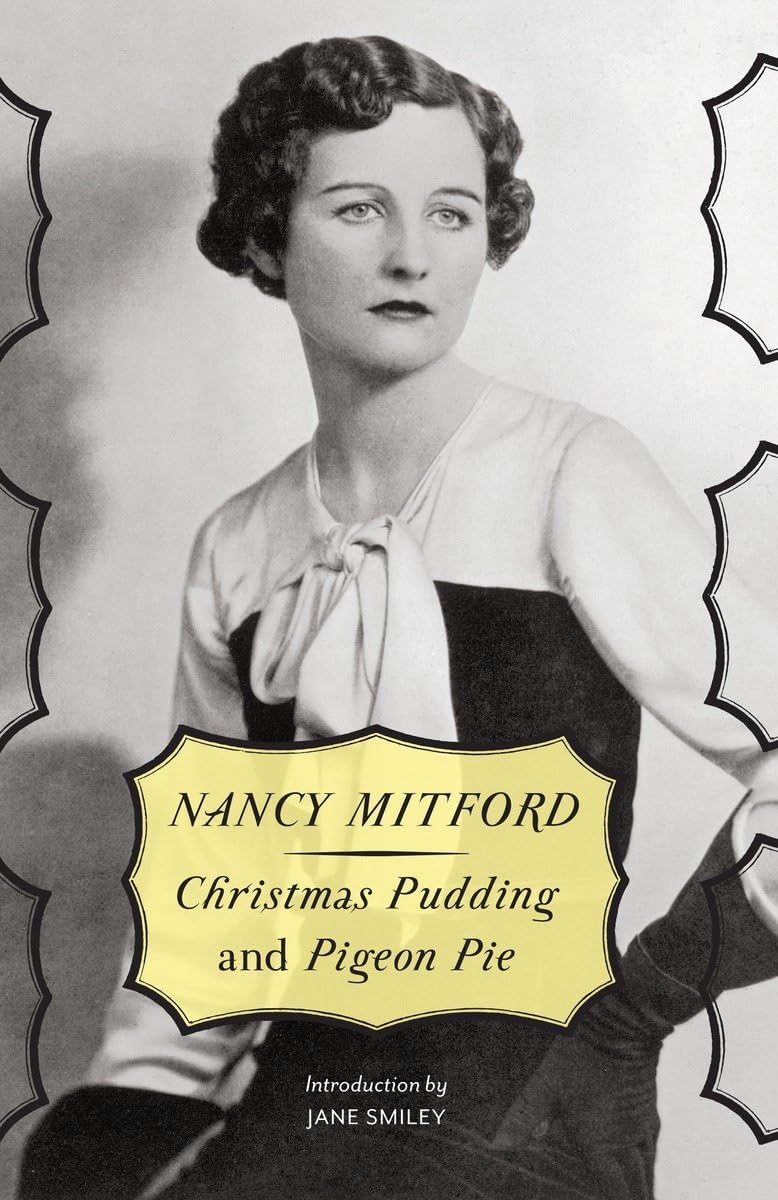
Christmas Pudding by Nancy Mitford: Plot, Themes & Review
Read Christmas Pudding by Nancy Mitford for country-house chaos, romance, family pressure, sharp satire, and a Christmas classic that never turns sugary.

Why Christmas Pudding Is My Kind of Christmas Classic
Hi Bookish Besties, There are Christmas books I read because I want snow, twinkling lights, sentimental reunions, and enough holiday cheer to temporarily convince me nobody has ever argued over where to spend Christmas Day. Then there is Nancy Mitford‘s Christmas Pudding.
This is the book I reach for when I want Christmas atmosphere without everyone behaving beautifully. I want the country house. I want the guests. I want romance going sideways, family expectations getting in the way, somebody taking themselves far too seriously, and Nancy sitting quietly in the corner noticing how ridiculous everyone is. That is much closer to my preferred version of festive reading.
Published in 1932, Christmas Pudding is an early Nancy Mitford novel, written more than a decade before The Pursuit of Love. You can already see so many of the things she will become brilliant at: upper-class families operating according to their own strange logic, romantic misunderstandings, social performance, people desperate to be taken seriously, and comedy that works because Nancy refuses to underline the joke.

It is festive, but it isn’t sugary. It is cozy, but it has teeth. And honestly, I think Christmas literature needs more teeth.
What Is Christmas Pudding by Nancy Mitford About?
At the center of Christmas Pudding is Paul Fotheringay, a young novelist who has suffered the particular humiliation of having his work received in a way he absolutely did not intend. For a writer, I feel this in my bones.
Instead of accepting the misunderstanding gracefully and moving on with his life, Paul decides he needs to establish himself as a serious literary figure. His solution is to write a biography of Lady Maria Bobbin, a nineteenth-century poet whose papers are held by her family at Compton Bobbin. Naturally, getting access is not straightforward.
His literary ambitions bring him into the orbit of the Bobbin family and their Christmas gathering, where personal agendas, romances, family expectations, and social absurdities begin piling up around him. This is Nancy Mitford, so nobody simply arrives at a house, completes a sensible task, and leaves. There must be complications. Preferably several.
Christmas Is Really the Pressure Cooker
What I like about the Christmas setting is that Nancy doesn’t need to turn the holiday itself into the story. Christmas simply gives her an excellent excuse to put too many people in one house. Which, when you think about it, is one of the foundational principles of holiday chaos.
Everyone has arrived with expectations. People who might otherwise avoid one another are now sharing rooms, meals, traditions, and opinions. Families are performing their idea of what Christmas should look like while guests bring their own desires into the middle of it.
That is exactly the kind of environment Nancy understands. The decorations may be festive. The humans remain humans.
Paul Fotheringay Is What Happens When Creative Insecurity Becomes a Plot
Paul may be one of the reasons this book amuses me so much because his problem is very specific and also completely understandable. He wants control over how people understand his work. Good luck with that.
Once you put something into the world, readers are going to have opinions about it. They may see something you didn’t intend. They may completely misunderstand what you thought was obvious. They may love the part you barely thought about and ignore the thing you spent three weeks perfecting.
Paul responds to this normal creative nightmare with the calm maturity of deciding he must immediately prove everyone wrong. I understand the impulse more than I would like to admit.
His plan to reinvent himself through serious literary work gives the novel one of its funniest underlying ideas: the harder people try to control how the world sees them, the more material Nancy has.
Lady Bobbin Understands the Importance of Being in Charge
Then there is Lady Bobbin, who belongs to one of my favorite Nancy Mitford character categories: the person who has decided the world would run much more smoothly if everyone simply listened to her. She presides over Compton Bobbin with strong opinions about her household, her family, and the correct way for things to proceed. I love characters like this in fiction because I am not responsible for surviving their Christmas dinner.
Nancy is especially good at women whose power operates through households, marriages, invitations, expectations, and social rules. Their authority may look domestic from the outside, but that does not make it small.
Lady Bobbin understands her world. She knows how it should function. The problem, as always, is other people.
Amabelle Fortescue Brings the Glamour and the Disruption
Amabelle brings another energy into the book entirely. She is glamorous, socially confident, and far less interested in behaving according to the expectations surrounding her.
Characters like Amabelle are useful in Nancy’s fiction because they disturb the atmosphere merely by arriving. A tightly controlled social environment only stays controlled when everyone agrees to follow the same rules. Then somebody doesn’t. That is usually when Nancy starts having fun.
Amabelle brings romantic complications and another layer of social unpredictability into a household that already has more than enough going on. I would never invite half these people to an actual Christmas gathering. As fictional company, however, they are excellent.
The Plot Is Fun, but the Social Comedy Is the Real Reason I Read It
This is something I think matters when recommending Christmas Pudding. If you come to Nancy primarily for plot, you may be looking in the wrong place. I don’t read her because I desperately need to know whether every scheme succeeds exactly as planned. I read her because I want to watch what people reveal about themselves while the scheme is failing. That is the pleasure.
Someone is worried about reputation. Someone wants to be taken seriously. Someone wants a different romantic future. Someone is trying to maintain control. Someone else has wandered into the room without understanding that there was apparently a whole social structure they were expected to respect. Nancy watches all of them.
And because this is an early novel, I also enjoy seeing her developing the comic instincts that will become so effortless in her later work.
The Biggest Theme Is People Trying to Control the Story
The more I think about Christmas Pudding, the more I see control running underneath the novel. Paul wants to control his literary reputation. Families want to control their children. People want to control romance. Hostesses want to control households. Society wants to control what counts as respectable. Everyone seems to have an idea of how events should unfold.
Nancy’s favorite thing is what happens next. Because other people have plans too. That collision between private expectation and inconvenient reality is one of the things she writes best.
Artistic Identity Gives the Book an Unexpectedly Relatable Center
I didn’t expect Paul’s creative problem to be one of the things I found most relatable about the novel, but here we are. There is something painfully funny about creating work, having other people interpret it, and realizing you no longer have complete authority over what it means once it belongs to readers.
Paul wants to correct the record. He wants to prove who he really is. And Nancy turns that anxiety into comedy because she understands how absurd we can become when we’re trying desperately to manage other people’s perceptions.
That idea doesn’t feel remotely dated to me. If anything, we have invented approximately nine hundred new ways to worry about how other people perceive us. Paul would have been terrible on social media.
Christmas Pudding Is Also About Family Obligation
Christmas is such a useful setting for family fiction because obligation becomes impossible to ignore. Who is expected to be there? Who has to behave? Who is supposed to marry whom? Who gets to make decisions? Who has been assigned a role in the family without necessarily agreeing to it?
Nancy understands that families often operate through expectations nobody remembers formally establishing. The Bobbin household has its own rules and assumptions, and much of the comedy comes from watching individual desire run directly into them.
That is one of the reasons the book still works for me as Christmas reading. The surroundings are specific to its period. The experience of somebody having a very firm opinion about how everyone else should spend the holiday has survived beautifully.
Romance in Christmas Pudding Is More Comic Than Sweeping
If you’re searching for a Christmas romance, I would adjust your expectations before opening this one. There is romance. There are attractions. There are misunderstandings and romantic complications. But this is Nancy Mitford, not a Christmas movie where a bakery is about to be saved by someone unexpectedly handsome.
Romance is another arena where people misunderstand themselves and one another. That is much more Nancy’s style. Her characters want things. They project fantasies. They make assumptions. They become interested in people who complicate their lives. Love is appealing partly because it creates such wonderful disorder. I appreciate that.
The Aristocracy Is Already Becoming Nancy’s Favorite Target
Even this early in her career, Nancy is clearly fascinated by the upper-class world she knew personally. But what I like about her satire is that she doesn’t simply point at wealthy people and announce that they are ridiculous. She understands the internal logic of the world too well for that.
She knows which social rules matter to the people following them. She knows how class appears through language, marriage, manners, houses, money, and confidence. And because she understands the system, she knows exactly where to poke it.
That insider perspective is what gives her satire such an easy quality. She’s not visiting the drawing room. She already knows where everyone sits.
Christmas Pudding Feels Different Once You’ve Read Later Nancy
I actually think this book gets more interesting if you’ve already read The Pursuit of Love or Love in a Cold Climate. You can see Nancy becoming Nancy. The wit is there. The class comedy is there. The difficult families are absolutely there. So are the romantic misunderstandings and characters attempting to live according to expectations that do not quite fit them.
Her later novels feel more emotionally controlled to me. The comedy and sadness are more seamlessly fused. Here, I can almost see her experimenting. I enjoy that. It feels like meeting a writer before everything has settled into place.
Is Christmas Pudding Actually a Christmas Book?
Yes. But perhaps not in the way someone searching for a traditional Christmas novel expects. I would call it a Christmas-set comedy of manners before I would call it a heartwarming holiday story.
The festive gathering matters because it puts the characters together and amplifies their existing problems. Christmas provides the house-party structure, the obligations, and the atmosphere. Nancy provides the misbehavior.
So if your definition of a Christmas book requires enormous emotional emphasis on the magic of the season, this may not satisfy that particular craving. If your definition includes eccentric relatives, country houses, social disaster, romantic confusion, and people being forced into one another’s company because it is Christmas? Come sit by me.
Why I Think It Belongs on a Holiday Reading List
My Christmas reading gets very sweet very quickly. Sometimes I want that. I will happily read the charming bookshop, the snowy village, the rediscovered love, and the conveniently available cottage. But eventually I need contrast. That is where Christmas Pudding works beautifully.
It still feels seasonal without requiring me to believe December temporarily cures every human flaw. Nobody becomes less vain because there is holly in the room. Nobody stops meddling because Christmas dinner is approaching. People remain ambitious, romantic, insecure, controlling, funny, and completely themselves. Oddly enough, I find that comforting too.
Who Should Read Christmas Pudding?
I would recommend this to readers who like witty British classics, country-house novels, dysfunctional families, social comedy, romantic misunderstandings, and Christmas books that aren’t particularly interested in making you cry over a miraculous holiday reunion. It is also a natural next read if you already love Nancy Mitford and want to explore the earlier novels that came before The Pursuit of Love.
And if you’re trying to read more classics but want something seasonal and relatively approachable, Nancy is a very friendly place to start. She expects you to notice things. She does not expect you to suffer. I appreciate that in a classic author.
Is Christmas Pudding the Best Nancy Mitford Book to Start With?
For most readers, I would still start with The Pursuit of Love. That is Nancy at the point where her warmth, comedy, family observation, and emotional sharpness come together most beautifully for me.
But if it is December and you’re looking at Christmas Pudding thinking the timing feels too perfect to ignore, I am certainly not going to stop you. This is especially true if you already know you enjoy comedy of manners. Sometimes seasonal reading rules outrank reading-order rules. I don’t make the system.
Why This Book Stays on My Christmas Shelf
What keeps Christmas Pudding in my seasonal rotation is precisely that it does not try very hard to become a Christmas classic. It doesn’t need to. The holiday gives Nancy the setting. The characters provide the entertainment.
I get the country-house atmosphere I want from a winter book, but I also get creative insecurity, family control, class satire, romantic confusion, and the reassuring knowledge that people have apparently always been making Christmas more complicated than necessary. That feels festive enough for me.
Final Thoughts
For me, Nancy Mitford’s Christmas Pudding works because it understands something very useful about the holidays: putting people into a beautiful house at Christmas does not automatically make them behave better. It may actually make everything worse. And therefore much more entertaining.
This isn’t the book I would choose when I want a sentimental Christmas story. It is the one I choose when I’ve already had plenty of sweetness and would like somebody to quietly start judging the guests. Nancy can handle that.
I love the country-house setting, the literary joke at Paul’s expense, the romantic complications, and the sense that everyone is trying to arrange life according to their own plans while everyone else’s plans keep getting in the way. Most of all, I love that the book feels festive without losing Nancy’s edge.
Because my favorite Christmas reads do not have to insist that the season is magical. Sometimes I just want the tree lit, the kettle on, a blanket nearby, and a novelist who understands that there is nothing quite as funny as a family gathering where everybody has arrived with expectations. That is Christmas Pudding. And for me, that earns it a permanent place on the Christmas shelf.