Agatha Christie: The Mother of the Cozy Mystery Review
My Agatha Christie: The Mother of the Cozy Mystery review explores Nancy West’s biography, its 100 short entries, and why Christie fans should read it.
The Woman Behind the Queen of Crime: Why Nancy West’s Agatha Christie Biography Is Worth Reading
Hi Bookish Besties! I’ve spent so much time reading and writing about Agatha Christie’s mysteries that I’ve started thinking about something beyond the murderers, the clues, and those wonderfully satisfying endings. What about the woman who created them? We know Hercule Poirot, with his little grey cells and extraordinary confidence. We know Miss Marple, quietly observing the residents of St. Mary Mead and recognizing things everyone else overlooks. And we know the kind of mystery Christie could construct from something as ordinary as a dinner party, a train journey, or an afternoon visit. But how much do we really know about Agatha Christie herself? That’s the question that makes Agatha Christie: The Mother of the Cozy Mystery by Nancy West such an appealing book to me. Published in 2026 as part of the Pocket Portraits series, this beautifully designed literary biography introduces readers to the life behind the Queen of Crime through 100 short entries. And I think there’s something particularly fitting about that approach.
Christie is one of the most successful novelists in literary history, yet she remains a surprisingly elusive figure. She created unforgettable characters, traveled extensively, experienced profound personal upheaval, and developed a writing career that continued for decades. But her public image was often considerably quieter than the life she actually lived. Agatha Christie: The Mother of the Cozy Mystery by Nancy West is a 240-page literary biography that explores Christie’s life, work, relationships, and lasting influence through 100 short, accessible entries. Combining biographical research with excerpts from Christie’s writing and reflections on her literary achievements, the book offers both longtime admirers and newer readers an inviting introduction to the woman behind some of the world’s most beloved mysteries. And after spending so much time with Miss Marple through my Miss Marple Reading Challenge, I think this is exactly the kind of companion book that adds another dimension to the reading experience. Because once you begin understanding the woman behind the stories, you start recognizing just how much of her own world found its way onto the page.
About Agatha Christie: The Mother of the Cozy Mystery by Nancy West
Agatha Christie: The Mother of the Cozy Mystery is an illustrated literary biography exploring the life and creative legacy of one of the world’s most influential mystery writers. Through 100 short entries, author Nancy West traces Christie’s experiences from her childhood in Devon through her wartime nursing, marriages, international travels, literary successes, and later years. Along the way, West connects events in Christie’s personal life with the themes, settings, and characters that made her detective fiction so enduring. The book also incorporates quotations, excerpts, and literary observations that allow readers to move between Christie’s biography and her work. Rather than presenting an intimidating chronological study, West offers a concise but substantial introduction to a writer whose life was considerably more adventurous and complicated than her conventional public image suggests. For readers who love Miss Marple, Hercule Poirot, or classic detective fiction, it’s a particularly appealing way to learn more about the woman responsible for creating them.

The Book at a Glance
- Title: Agatha Christie: The Mother of the Cozy Mystery
- Author: Nancy West
- Publication date: July 14, 2026
- Publisher: Adams Media
- Series: Pocket Portraits
- Length: 240 pages
- Format: Hardcover, ebook, and audiobook
- Genre: Literary biography, nonfiction, and literary history
- Best for: Agatha Christie fans, classic mystery readers, literary biography lovers, and anyone interested in the lives of famous women writers
- My overall impression: An accessible, thoughtfully researched, and beautifully presented introduction to Christie’s life that offers more substance than its compact size might suggest.
Who Is Nancy West?
Before getting into the biography itself, I think it’s worth knowing a little about the woman who wrote it. Nancy West is a professor of English at the University of Missouri and a literary scholar whose previous books include Kodak and the Lens of Nostalgia, Tabloid, Inc.: Crimes, News, Narratives, and Masterpiece: America’s Fifty-Year-Old Love Affair with British Television Drama.
I find her background particularly interesting because her work explores popular culture, storytelling, media, and the ways audiences connect with familiar cultural experiences. And when you think about it, Agatha Christie is a wonderful subject for someone interested in those questions. Christie wasn’t simply a bestselling author whose books happened to become popular. She helped shape the way generations of readers understand detective fiction.
Her characters became cultural institutions. Her stories inspired television adaptations, films, plays, and countless writers who followed in her footsteps. And her public image became almost as recognizable as the fictional worlds she created. What I particularly appreciate about West’s approach is her interest in the difference between that public image and the woman behind it.
In interviews about the book, West has discussed how Christie cultivated an image of conventionality, particularly after the extraordinary publicity surrounding her disappearance in 1926. But the reality of Christie’s life was considerably more complicated. She was a traveler, a mother, a nurse, an accomplished businesswoman, and someone who had experienced both extraordinary professional success and significant personal difficulties.
I think that’s a fascinating place to begin a biography. Because the more we learn about Christie, the more difficult it becomes to reduce her to the familiar image of a pleasant Englishwoman who happened to write stories about murder.
What Makes This Agatha Christie Biography Different?
One of the biggest things that distinguishes this book from a traditional literary biography is its structure. Instead of presenting several hundred pages of continuous narrative, West organizes Christie’s life into 100 short entries. And I think that’s a clever approach for a book about such a prolific author.
One Hundred Short Entries Make the Biography Easy to Pick Up
Sometimes I love sitting down with an enormous biography and immersing myself in every detail of a writer’s life. But there are other times when I want something a little less demanding. Perhaps I’m between novels, enjoying a quiet afternoon, or simply in the mood to learn something interesting without committing to a long chapter. That’s where the Pocket Portraits format becomes particularly appealing. Each entry offers a manageable piece of Christie’s story, allowing readers to move gradually through her life and literary career.
You could read several entries in one sitting or enjoy just one or two at a time. And because the book combines biography with literary excerpts and observations, it isn’t simply a timeline of important events. It encourages readers to consider how those experiences connect with the fiction Christie eventually wrote. I think that’s a particularly enjoyable way to approach literary history.
The Book Connects Christie’s Life With Her Writing
What interests me most about this biography is that West doesn’t treat Christie’s personal experiences and literary achievements as completely separate subjects. Instead, she explores the connections between them. Christie’s wartime medical training becomes relevant to her extraordinary knowledge of poisons. Her travels help explain her interest in unusual locations and the different kinds of people she encountered.
And the emotional experiences of her life provide another way of understanding the loneliness, grief, ambition, and complicated relationships that appear throughout her fiction. I think this is particularly valuable because Christie is sometimes discussed primarily as a master of plotting. And she certainly deserves that reputation. But after reading so many of her novels, I’ve become increasingly interested in her understanding of people.
Her mysteries may begin with a suspicious death. But the motives often involve very familiar experiences. Disappointment. Jealousy. The desire for security. The fear of growing older. Or the painful realization that someone we love isn’t quite the person we thought they were. I think West’s biography offers a useful opportunity to consider where some of that emotional understanding may have come from.
It’s Also a Beautifully Designed Little Book
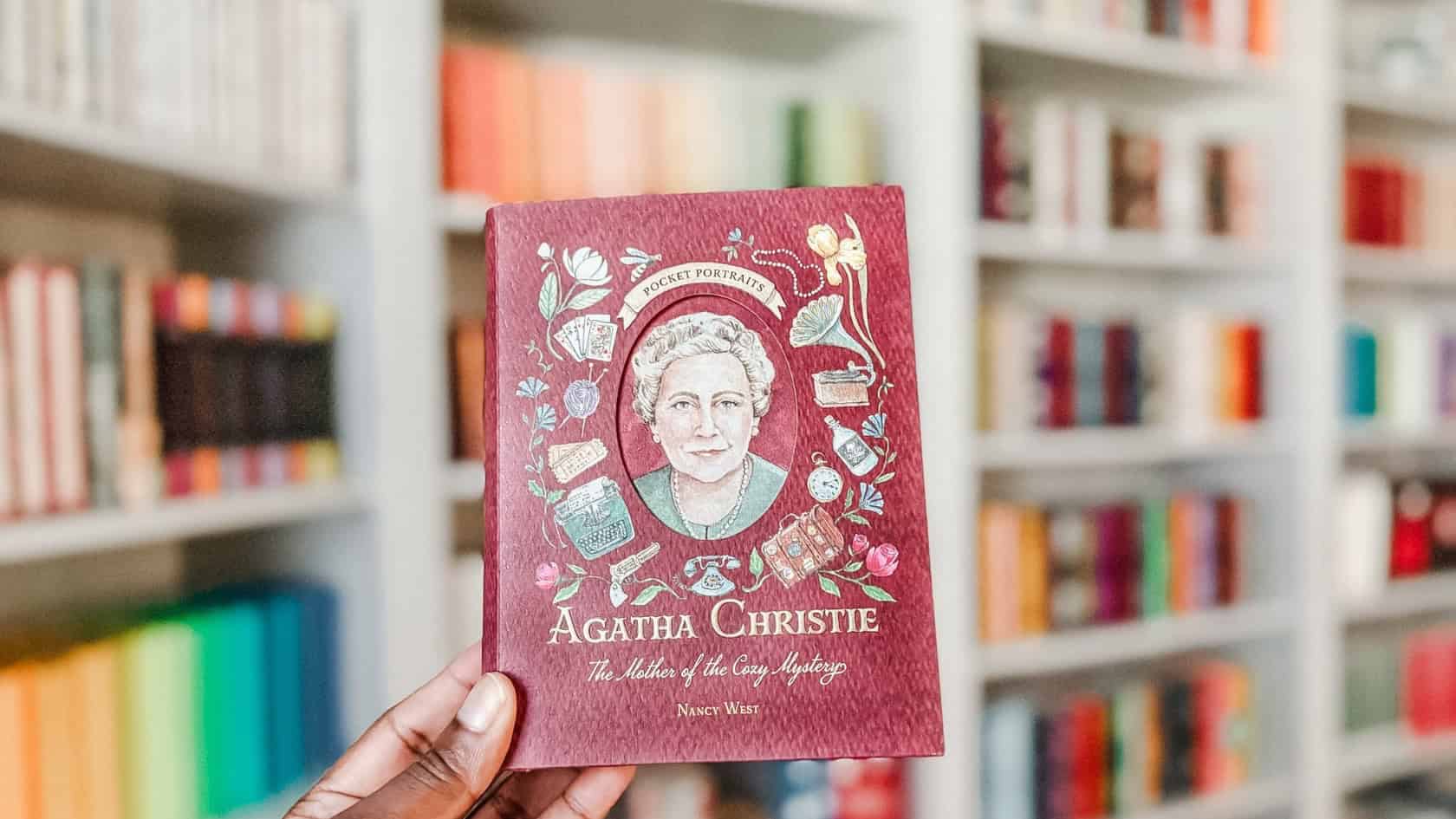
Another thing worth mentioning is the physical presentation. The Pocket Portraits series is designed to offer compact, attractive biographies of influential literary figures. This volume is a small hardcover, measuring approximately 4.5 by 6 inches, with an illustrated cover featuring Christie surrounded by objects that evoke her writing. The cover artwork, created by Kim Arrington, incorporates details associated with mystery fiction and Christie’s literary world.
And I think that’s a lovely touch. It’s the kind of book that feels particularly appealing to someone who enjoys collecting editions of favorite authors. Not because an attractive cover makes the writing better. But because there’s something satisfying about owning a book that celebrates the author both intellectually and visually. I can easily imagine this sitting beside a collection of Christie paperbacks, waiting to be picked up whenever you’re in the mood to learn a little more about her life.
What You’ll Learn About Agatha Christie’s Life
One of the things that makes Christie such an interesting biographical subject is how much she experienced beyond her writing career. It’s easy to imagine her spending decades quietly producing murder mysteries from a comfortable English home. But her actual life included international travel, wartime service, two marriages, archaeological expeditions, public controversy, and extraordinary professional achievement. And I think understanding those experiences makes her fiction considerably more interesting.
Her Childhood in Devon and Her Love of Reading
Agatha Christie was born in Torquay, Devon, in 1890. She grew up in a relatively comfortable household and spent much of her childhood learning at home, surrounded by books and encouraged to use her imagination. I think that’s a particularly lovely beginning for someone who would eventually become one of the most widely read novelists in history. There’s something wonderful about imagining the young Agatha discovering stories long before she had any idea how many readers would eventually discover hers.
And I think childhood is an especially interesting part of an author’s biography. It gives us an opportunity to consider how early experiences shape the things a writer eventually becomes fascinated by. For Christie, those interests included storytelling, imaginative play, and the pleasure of creating fictional worlds. And as we know, she eventually became exceptionally good at creating worlds where almost everyone had something to hide.
Her Work as a Nurse Helped Shape Her Mysteries
This is one of the most fascinating connections between Christie’s personal life and her fiction. During the First World War, Christie worked as a volunteer nurse and later trained in a hospital dispensary. That experience gave her practical knowledge of medicines, their uses, and the potentially deadly consequences of incorrect doses. And if you’ve read much Christie, you already know how important poisons become in her stories.
From The Mysterious Affair at Styles onward, she frequently uses substances that can be administered discreetly and produce symptoms that aren’t immediately understood. I think there’s something particularly satisfying about knowing that this wasn’t simply an author inventing improbable scientific explanations. Christie had genuine knowledge of the subject. She understood the importance of dosage. She knew how different substances affected the body.
And she could incorporate that knowledge into mysteries without requiring an elaborate or implausible murder weapon. After reading so many of her novels, I think this is one of those biographical details that becomes more interesting every time another suspicious cup of tea appears.
How Hercule Poirot Began
Christie’s first detective novel, The Mysterious Affair at Styles, was published in 1920. And with it, she introduced a character who would become one of the most recognizable detectives in literary history. Hercule Poirot. The meticulous Belgian detective, with his extraordinary confidence and attention to order, would go on to appear in dozens of Christie’s mysteries. What I find interesting about Poirot’s creation is the way Christie’s wartime experiences influenced her imagination.
Belgian refugees had come to Britain during the First World War, and Christie drew upon that historical context when imagining her detective. I love learning details like this because they remind us how often fictional characters emerge from a writer’s observations of the real world. Someone notices a particular type of person. Or becomes interested in a social circumstance. And eventually, that observation becomes the foundation of a character who lives far beyond the original moment. Poirot certainly did.
The Creation of Miss Marple
Of course, this is the part of Christie’s career I’m particularly interested in right now. Miss Marple made her first appearance in the short story The Tuesday Night Club, published in 1927, before appearing in her first full-length novel, The Murder at the Vicarage, in 1930. And I think she’s one of Christie’s most fascinating creations. An elderly woman living in a quiet English village doesn’t sound like the obvious choice for a formidable detective.
But that’s exactly what makes Miss Marple so effective. People underestimate her. They assume that her interest in village gossip is trivial. And they don’t recognize that decades of observing ordinary human behavior have given her an extraordinary understanding of motive and character. One of the things I’ve appreciated most through my Miss Marple Reading Challenge is watching how Christie develops those qualities across the novels.
Miss Marple becomes older. Her circumstances change. But her intelligence and sense of justice remain remarkably consistent. And I think reading about the author behind the character adds an interesting dimension to that development. Especially when we consider how Christie’s own experiences of aging and social change may have influenced her later fiction.
Christie’s Personal Life Wasn’t Nearly as Conventional as Her Public Image
I think one of the most appealing things about West’s biography is the way it looks beyond Christie’s literary achievements. Because Christie wasn’t simply someone who wrote extraordinary books. She was a woman living through extraordinary changes in society. And her personal experiences weren’t always easy.
Her First Marriage and the Difficult Year of 1926
Christie married Archibald Christie in December 1914, during the First World War. They had a daughter, Rosalind, and for a time their marriage formed an important part of Christie’s early adult life. But the relationship eventually deteriorated. And 1926 became an especially difficult year. Christie’s mother died, her marriage was breaking down, and she was dealing with considerable emotional strain. Then, in December, she disappeared for eleven days.
Her abandoned car was discovered, a major search followed, and newspapers became consumed with speculation about what had happened. Eventually, Christie was found staying at a hotel in Harrogate. But the reasons behind her disappearance have remained a subject of debate for generations. And I think that’s something worth approaching carefully. Christie spent her career writing mysteries, so it’s tempting to treat her disappearance as another puzzle waiting for a clever solution.
But she was also a real person experiencing a deeply painful period in her life. I appreciate biographical writing that recognizes that distinction. We can discuss the documented events, the public response, and the impact on her life without pretending we can establish exactly what she was thinking or feeling.
Her Second Marriage and Her Love of Travel
Christie’s later marriage to archaeologist Max Mallowan opened another fascinating chapter of her life. The couple married in 1930 and traveled extensively, particularly in the Middle East, where Max worked on archaeological excavations. Christie became involved in aspects of archaeological life and developed a deep affection for travel. And I think that becomes especially interesting when we consider the settings of her books.
Murder on the Orient Express. Death on the Nile. Murder in Mesopotamia. Those stories don’t feel quite so disconnected from her own experiences once we understand how much time Christie spent traveling and encountering people from different backgrounds. I’ve always enjoyed her ability to create mysteries in places that feel like complete little worlds. A train. A ship. A hotel. An archaeological expedition. Each setting brings together a particular group of people whose relationships gradually become essential to the investigation. And I think there’s something particularly enjoyable about discovering that the woman who wrote those stories had a genuine appetite for adventure herself.
She Was Also a Playwright and Wrote Outside the Mystery Genre
Another thing I think we sometimes overlook is just how varied Christie’s career became. She’s best known for her sixty-six detective novels and fourteen short story collections. But she also wrote for the stage, including The Mousetrap, which became one of the most remarkable theatrical successes in history. And under the pseudonym Mary Westmacott, she wrote six novels that explored personal relationships and emotional experiences outside the conventions of detective fiction.
I think that’s particularly fascinating. Because it challenges the idea that Christie was interested only in constructing clever murders. She clearly had broader literary interests. And some of the emotional concerns we encounter in her mystery novels become even more obvious when we consider her work in other genres. I appreciate a biography that treats those different aspects of a writer’s career as part of the same creative life. Rather than presenting the famous detective novels as though they were her only important achievements.
Was Agatha Christie Really the Mother of the Cozy Mystery?
Now, I want to talk about the book’s subtitle because I think it raises an interesting question. Was Agatha Christie really the mother of the cozy mystery? I understand why she’s described that way. Christie helped establish many of the conventions we now associate with traditional cozy mysteries. Small communities. Amateur detectives. Contained groups of suspects. Murder investigations that emphasize deduction rather than graphic violence.
And characters whose ordinary social interactions reveal the clues necessary to solve a crime. Miss Marple, in particular, has become one of the defining figures associated with this tradition. But I also think the label can be a little misleading.
Christie’s Books Aren’t Always Particularly Cozy
When people hear the phrase “cozy mystery,” they often imagine charming villages, comfortable homes, and stories that provide a relatively gentle escape from everyday life. And some Christie novels certainly offer that atmosphere. But the crimes themselves are often considerably darker. Think about And Then There Were None, where a group of people becomes trapped in a terrifying situation and begins dying one by one.
Or The Mirror Crack’d from Side to Side, where grief and personal trauma become central to the investigation. Or A Pocket Full of Rye, where the exploitation of a vulnerable young woman gives the story an emotional weight far beyond its clever nursery-rhyme structure. Those aren’t simply comforting stories with a little murder added for entertainment. They’re mysteries about some of the most disturbing aspects of human behavior. And I think that’s part of what makes Christie so enduring.
She Understood the Darkness Beneath Ordinary Life
One of the things I’ve become increasingly convinced of through my reading challenge is that Christie was an exceptionally perceptive observer of people. Her plots are clever, certainly. But she also understood loneliness, resentment, ambition, disappointment, and the lengths people will go to protect their idea of themselves. And those themes often matter just as much as the mechanics of the murder. I think that’s where the title The Mother of the Cozy Mystery becomes especially interesting.
Christie helped establish the traditions that later generations would develop into modern cozy mysteries. But she also wrote stories that resist being comfortably contained within that category. And I appreciate any biography that encourages readers to recognize the complexity of her work rather than reducing it to a pleasant literary stereotype.
Why This Biography Pairs So Well With My Miss Marple Reading Challenge
One of the things that has surprised me most about working through Agatha Christie’s twelve original Miss Marple novels is how much my understanding of the detective has changed. When I first began, I thought I would mainly be revisiting familiar mysteries. Remembering the plots. Admiring the clever endings. And enjoying the familiar atmosphere of St. Mary Mead. But as I’ve continued reading, I’ve become far more interested in how Christie portrays age, experience, changing communities, and the complicated emotions that influence people’s behavior. And I think that makes a biography like West’s particularly valuable.
Miss Marple Reflects Christie’s Interest in Aging and Independence
In The Murder at the Vicarage, Miss Marple is already an elderly woman whose intelligence is regularly underestimated. But as the series progresses, her circumstances change. She experiences illness. She becomes less physically active. And she’s increasingly aware that the world around her isn’t the same place she remembers. Yet she remains remarkably perceptive. In 4.50 from Paddington, she recognizes when she needs someone else to carry out the physical investigation and recruits the wonderfully capable Lucy Eyelesbarrow.
In The Mirror Crack’d from Side to Side, she struggles with the well-meaning but overbearing assistance of a companion who doesn’t always respect her independence. And in A Caribbean Mystery, she travels abroad and demonstrates that her understanding of human nature is just as effective outside St. Mary Mead. I think those stories become even more interesting when we consider Christie herself growing older while continuing to write.
The detective and her creator were both observing a changing world. And both seemed particularly interested in what happens when older women are underestimated.
Understanding Christie Makes the Emotional Mysteries More Interesting
Another thing I’ve been paying attention to is the emotional foundation of Christie’s later novels. The Mirror Crack’d from Side to Side is a particularly memorable example because the mystery depends upon understanding grief and the lasting consequences of a painful experience. And I think that’s the sort of story that challenges the idea that Christie was interested only in clever tricks. She understood how a person’s past could shape their present behavior.
How an apparently insignificant encounter might have entirely different meanings to the people involved. And how emotional pain could influence someone’s decisions in ways that weren’t immediately obvious. I think West’s biography offers another way of appreciating those qualities. Not because every fictional experience must correspond directly to something that happened in Christie’s life. That would be far too simplistic. But because understanding an author’s experiences can help us recognize the questions and themes that interested her throughout her career.
It Reminds Me Why I Love Reading Authors in Context
This may be my favorite reason to recommend the book. I love reading a novel simply for the pleasure of the story. But I also enjoy learning about the writer who created it. What was happening in the world when the book was written? What experiences shaped the author’s perspective? And how did their personal circumstances influence the kinds of characters and stories they wanted to explore? Those questions don’t necessarily change whether a novel is enjoyable.
But they can make the reading experience richer. And I think that’s particularly true of an author as prolific as Christie. After spending time with her characters, it’s lovely to turn our attention toward the woman who imagined them.
My Review: What I Appreciate Most About Nancy West’s Approach
I think the strongest quality of Agatha Christie: The Mother of the Cozy Mystery is the balance between accessibility and substance. It’s a compact book, but it doesn’t approach its subject as though readers are interested only in a handful of familiar facts. West explores Christie’s childhood, relationships, wartime experiences, literary achievements, personal difficulties, and lasting influence. And I appreciate the effort to connect those subjects with the fiction itself.
It Makes Literary History Feel Approachable
One of the things I especially like about the 100-entry structure is that it removes some of the intimidation that can come with reading a biography. Not everyone wants to tackle an enormous scholarly study. And not everyone has the time to spend several weeks immersed in one author’s life. Sometimes we simply want a thoughtful introduction that helps us understand the person behind the books. I think West’s approach suits that kind of reader beautifully.
The entries are designed to be concise without treating the subject as trivial. And I like that distinction. Accessible doesn’t have to mean shallow. A biography can be inviting and informative at the same time.
It Celebrates the Woman, Not Just the Famous Books
Another thing I appreciate is that the book doesn’t limit itself to Christie’s professional achievements. Of course, those achievements are extraordinary. But there’s also something important about understanding her as a person. She experienced grief. She fell in love. She traveled. She raised a daughter. And she continued finding ways to write throughout periods of personal and social change. I think those experiences matter because they remind us that famous authors aren’t simply names printed on book covers.
They’re people who lived complicated lives while creating the stories we still enjoy. And I particularly appreciate a biography that encourages us to see both sides.
Even Longtime Christie Readers Can Learn Something
This is another reason I think the book is worth considering. After reading dozens of novels by the same author, it’s easy to assume we already know the important facts about their life. But literary biographies can reveal connections and details we haven’t previously considered. Perhaps we know Christie worked with medicines during the war. But we haven’t thought about how closely that experience relates to her early fiction.
Or perhaps we’re familiar with her travels but haven’t considered the practical ways those journeys influenced her settings and characters. I like the idea of a book that encourages those little moments of recognition. Not necessarily enormous revelations. Sometimes just a new detail that makes you look at a familiar novel differently. And for someone who’s already invested a great deal of time in Christie’s work, I think those discoveries can be particularly satisfying.
Where the Pocket Portraits Format May Not Be Enough
Now, I do think it’s important to have realistic expectations about this book. Because a 240-page biography divided into 100 short entries is necessarily going to approach its subject differently from a more expansive literary study. And that structure won’t be ideal for every reader.
Readers Wanting a Continuous Narrative May Prefer a Traditional Biography
If you enjoy biographies that develop a person’s life through long, detailed chapters, this format may feel a little fragmented. The short entries are designed to be approachable, but they also mean the book moves through experiences and subjects relatively quickly. I don’t necessarily consider that a weakness. It’s simply a different reading experience. For someone who enjoys dipping into a book over several evenings, the structure may be perfect.
But if you’re looking for an extended examination of Christie’s relationships, publishing history, or creative process, you may want something more substantial.
It Isn’t a Replacement for Christie’s Own Autobiography
I also think it’s worth remembering that Christie wrote about her own life. Her Autobiography, published after her death, provides a much more extensive personal account of her experiences, memories, and relationships. And I think that’s a wonderful book to consider if you’re particularly interested in understanding Christie through her own words. West’s biography offers a different perspective. It’s written by a literary scholar who can connect Christie’s experiences with her broader cultural and literary importance.
But it isn’t designed to replace the depth of a full autobiography. Personally, I think there’s room for both. A concise introduction can make us curious about the subject. And that curiosity may eventually lead us toward something more detailed.
Is Agatha Christie: The Mother of the Cozy Mystery Worth Reading?
Yes. I think it’s a particularly appealing choice for readers who love Agatha Christie and want an accessible but thoughtful introduction to her life. What makes the book worthwhile isn’t simply the fact that it contains biographical information. You can find dates, publication lists, and basic facts about famous authors in plenty of places. What interests me is the way West connects those details into a portrait of a woman whose life and work were far more complicated than her familiar public image suggests.
I think that approach is especially valuable for readers who have spent years enjoying Christie’s novels without necessarily learning very much about the person who wrote them. And I appreciate that the book is designed to be welcoming. It doesn’t require an extensive knowledge of literary criticism. Nor does it assume every reader has already worked through the entire Christie bibliography. Instead, it offers a way into her life through short, engaging pieces that can be enjoyed gradually.
That said, I wouldn’t recommend it as the only biography someone should ever read about Christie. If you become particularly interested in her life, there are longer studies and her own autobiography worth exploring. But as a beautifully presented, informative introduction, I think West’s book accomplishes something useful. It reminds readers that behind the famous detective novels was a woman who lived a remarkable life. And for me, that’s a story worth exploring.
Is This a Good Book for Someone New to Agatha Christie?
Absolutely. In fact, I think the accessible format makes it a particularly good introduction for readers who are curious about Christie but don’t know very much about her life. You don’t need to have read all sixty-six detective novels. You don’t need to know every Poirot mystery. And you certainly don’t need to be an expert on Golden Age detective fiction. West introduces the major events and achievements in a way that’s designed to be approachable.
However, I do think there’s something especially satisfying about reading a few Christie novels first. Once you’ve encountered Poirot, Miss Marple, and some of Christie’s most famous mysteries, the biographical details become more meaningful. You begin recognizing the names. Understanding the literary references. And appreciating how experiences from her life may have influenced particular stories. So if you’re completely new to Christie, I’d suggest reading one or two of her novels and then picking up this biography. But if you’re already a longtime admirer, I think you’ll find plenty to appreciate as well.
Would This Make a Good Gift for an Agatha Christie Fan?
I think this is one of the book’s strongest selling points. The compact hardcover format, illustrated cover, and accessible entries make it a particularly appealing gift for someone who enjoys classic mysteries. And because it isn’t simply another edition of a Christie novel, it offers something a little different. If someone already owns Murder on the Orient Express, And Then There Were None, and several Miss Marple novels, they may not need another copy of those stories.
But a literary biography that celebrates the author behind them could be a lovely addition to their collection. I also think it would make a thoughtful gift for someone who’s just beginning to explore Christie. Perhaps they’re starting a Miss Marple reading challenge. Or they’ve recently discovered Poirot through television adaptations. Or they simply enjoy learning about influential women writers. The short-entry format makes the book approachable without requiring the recipient to commit to an enormous biography.
And I think the presentation gives it a little more personality than an ordinary paperback. It’s the sort of book I could imagine pairing with a favorite Christie novel for a particularly lovely bookish gift.
How Does It Compare With Other Books About Agatha Christie?
If you’re interested in exploring Christie’s life and literary legacy, there are several different approaches worth considering. And I think it helps to understand what each kind of book offers.
Nancy West’s Biography: Best for an Accessible Introduction
Agatha Christie: The Mother of the Cozy Mystery is ideal if you want an approachable overview of Christie’s life without committing to a lengthy study. The 100 entries make it easy to read gradually, while the inclusion of literary excerpts and biographical observations gives readers opportunities to connect her experiences with her fiction. I think it’s a particularly good choice for casual readers and longtime fans who want a beautifully presented companion book.
Agatha Christie’s Autobiography: Best for Her Own Perspective
If you want to spend considerably more time with Christie herself, her Autobiography offers a much fuller account of her life. It’s especially interesting for readers who enjoy hearing writers describe their childhoods, relationships, travels, and creative experiences in their own words. Of course, an autobiography is necessarily shaped by what the author chooses to remember and share. And that can make it interesting to read alongside a biography written by someone else. The two approaches aren’t competing. They provide different perspectives.
The Original Christie Novels: Best for Understanding Her Talent
And of course, there’s no substitute for reading Christie’s fiction. A biography can help explain her experiences, influences, and career. But the novels themselves demonstrate what made her such an extraordinary storyteller. If you’re particularly interested in Miss Marple, you can follow all twelve original novels through my Miss Marple Reading Challenge. And if you want to explore more of Christie’s writing, you can browse my Agatha Christie reading guides and articles.
I think the combination is particularly satisfying. Read the books. Learn about the writer. And then return to the books with a slightly different understanding of the person who created them.
Frequently Asked Questions About Agatha Christie: The Mother of the Cozy Mystery
Who Wrote Agatha Christie: The Mother of the Cozy Mystery?
The biography was written by Nancy West, a professor of English at the University of Missouri and author of several books exploring literary culture, media, and popular entertainment.
When Was Nancy West’s Agatha Christie Biography Published?
Agatha Christie: The Mother of the Cozy Mystery was published in the United States on July 14, 2026, by Adams Media, as part of the Pocket Portraits series.
How Many Pages Are in the Book?
The hardcover edition has 240 pages and is organized around 100 short entries exploring Agatha Christie’s life, literary career, and lasting influence.
Is This Book Written by Agatha Christie?
No. It’s a biography about Agatha Christie written by Nancy West. It includes material about Christie’s life and excerpts from her work, but it isn’t a Christie novel or a previously unpublished manuscript.
Is The Mother of the Cozy Mystery a Novel or a Biography?
It’s a nonfiction literary biography. Rather than following a fictional murder investigation, it explores the experiences, achievements, and relationships that shaped Agatha Christie’s life and writing.
Does the Biography Discuss Miss Marple and Hercule Poirot?
Yes. Christie’s famous detectives and the stories that made them so popular are important parts of her literary legacy, and West explores connections between Christie’s experiences and her writing.
Do I Need to Read Agatha Christie’s Books Before This Biography?
No. The book is designed to be accessible to newcomers as well as longtime admirers. However, if you’re especially sensitive to learning details about famous mystery plots before reading them, you may prefer to begin with a few of Christie’s novels and return to the biography afterward.
Is There an Audiobook Edition?
Yes. An unabridged audiobook edition is available, narrated by Pearl Hewitt. There’s also an ebook edition for readers who prefer digital reading.
Is Agatha Christie Really Considered the Mother of Cozy Mysteries?
Christie is one of the most influential writers in the development of traditional detective fiction, and Miss Marple helped establish many of the conventions associated with modern cozy mysteries. However, not all of Christie’s work fits today’s definition of cozy fiction, and some of her most famous novels are considerably darker.
My Final Thoughts on Agatha Christie: The Mother of the Cozy Mystery
I think one of the loveliest things about being a reader is discovering that a favorite book can lead us toward so many other interesting subjects. We begin with a mystery. Then perhaps we read another book by the same author. Before long, we’re working our way through an entire series, learning about the period in which the books were written, and becoming increasingly curious about the person who created them. That’s certainly been my experience with Agatha Christie.
What began as an opportunity to revisit Miss Marple has become a much deeper appreciation for Christie’s understanding of human nature, her remarkable storytelling abilities, and the extraordinary range of her literary career. And I think Nancy West’s Agatha Christie: The Mother of the Cozy Mystery is a lovely companion to that kind of reading journey. The format is approachable. The subject is fascinating. And the connections between Christie’s personal experiences and her literary achievements offer readers plenty to think about.
But perhaps what I appreciate most is the reminder that Agatha Christie was considerably more interesting than the quiet, conventional image often associated with her name. She was adventurous. She traveled. She experienced love and loss. She lived through extraordinary changes in society. And throughout it all, she continued creating stories that have entertained readers for generations. I think that’s a remarkable life. And one worth celebrating beyond the mysteries themselves.
My recommendation is to add this biography to your reading list if you love Christie, enjoy literary history, or want an accessible introduction to the woman behind the Queen of Crime. It’s particularly appealing as a companion to her original novels, and I think the beautifully designed hardcover would make a thoughtful gift for another mystery reader.
If you’ve been following my Miss Marple Reading Challenge, I’d suggest picking it up whenever you’re in the mood for a little nonfiction between mysteries. There isn’t a required place for it in the reading order. And you don’t need to wait until you’ve finished all twelve novels. Sometimes it’s nice to spend a little time learning about the author before returning to the world she created. And in Christie’s case, I think there’s more than enough material to keep us curious.
Let’s Discuss Agatha Christie and Her Extraordinary Life
Now, I’d love to hear your thoughts. Have you read a biography about Agatha Christie, or have you mostly gotten to know her through her novels? I’m particularly curious whether you enjoy learning about the lives of your favorite authors and whether understanding their personal experiences changes the way you read their books. And if you’re already a Christie fan, I’d love to know which part of her life you find most fascinating. Her childhood and early writing career? Her travels and archaeological adventures? The creation of Miss Marple and Hercule Poirot? Or perhaps the extraordinary longevity of her career? Leave a comment below and tell me what you think. And if you’re interested in exploring more of Christie’s work, you can find my reading guides, author articles, and the complete twelve-novel Miss Marple Reading Challenge through my Agatha Christie collection.
There’s no need to rush through them. I think Christie is the kind of author whose books become even more rewarding when we give ourselves time to appreciate them. Happy reading, bookish besties! I’ll see you in St. Mary Mead.