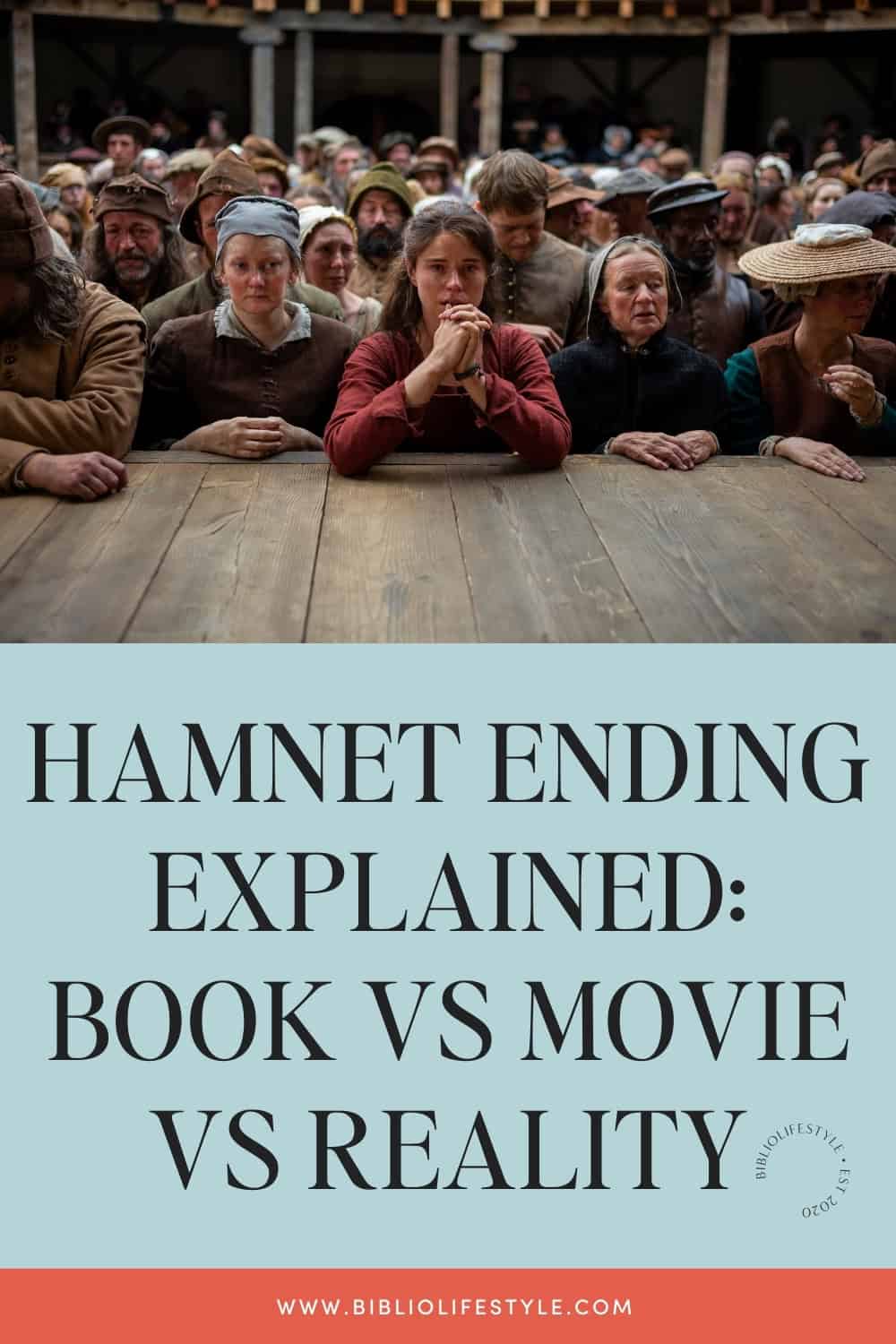
Hamnet Ending Explained: Book vs Movie vs Reality
Confused by the Hamnet ending? Here’s a clear, spoiler-aware breakdown of the movie finale, how it differs from the book, and what’s real in Shakespeare’s history.

Hamnet: Book vs Movie vs Reality (Ending Explained)
If you’ve just finished the Hamnet movie and typed “Hamnet ending explained” into Google while still wiping away tears-welcome, Bestie. You’re not alone. Welcome to my Hamnet book adaptation breakdown because after watching I had so many thoughts and wanted to share with you all!
The short version: the ending of Hamnet shows Agnes finally understanding that her husband has been grieving their son all along-just not in words, but in art. The play Hamlet becomes the way William brings Hamnet back to life on stage, Agnes has an opportunity to say goodbye, and turns private grief into a communal mourning and shared ritual for the audience.
But there are so many things to talk about, I’ll quickly walk you through:

- What actually happens in the Hamnet movie ending
- How that differs from Maggie O’Farrell’s novel
- What’s based on real history-and what’s pure imagination
- Whether you should read the book, watch the movie, or do both (and in what order)
Quick Answer: Hamnet Ending Explained (Spoilers)
- Years after Hamnet’s death, Agnes travels to London to see her husband’s new play, Hamlet.
- At first, she’s confused and angry that the tragedy seems unrelated to her son, despite sharing his name.
- Then three key things happen:
- She recognizes her lost son in the actor playing Hamlet.
- She watches Hamlet die on stage and instinctively reaches out, triggering a wave of communal grief in the audience.
- The film cross-cuts to a shadowy, liminal forest space where Hamnet walks peacefully into darkness, smiling, as if finally passing on.
- William plays the Ghost on stage, so he’s both the grieving father in real life and the dead father in the play.
- The meaning of it all: art becomes the bridge between the living and the dead. Shakespeare can’t talk about Hamnet directly, but he can build a world where their son symbolically lives, dies, and is remembered every time the play is performed.
So the Hamnet ending is less about solving a plot twist and more about answering this question: What do we do with grief we can’t carry alone? The movie’s answer is: we turn it into story, ritual, and shared experience.
Watch the Full Breakdown
I cover the ending, the real history we actually have, and the biggest book-versus-movie changes—so if you prefer video first, this is your starting point.
Step-by-Step: What Happens in the Hamnet Movie Ending
Let’s slow it down and walk through that final sequence in the film so the emotional beats actually make sense.
Key Moment 1: Agnes Recognizes Her Son on Stage
Agnes arrives at the Globe Theatre years after Hamnet’s death, carrying layers of grief, anger, and distance from her husband. She knows the play is called Hamlet-a name that, historically, was a common variant of Hamnet in Stratford’s records. At first, the play seems to have nothing to do with her child. It looks like a court drama, not a memorial. Then the actor playing Hamlet steps onto the stage. In the movie, this hits harder because of casting: the same real-life brothers play Hamnet earlier and Hamlet later, so the resemblance is deliberate. For Agnes, the actor isn’t just a character; he looks like her son. Once she sees Hamnet in him, the entire performance becomes a collision between theatre and memory.
Key Moment 2: Hamlet’s Death and the Audience’s Grief
When Hamlet dies in the final act, Agnes’s body reacts before her mind does. She reaches out toward the stage like a mother trying to grab her child one last time. The camera doesn’t just stay on her: it shows the entire audience rising into this wave of shared grief. This is important. The film is saying that loss isn’t only private-it becomes something communal when we experience it through art. In that moment, Agnes isn’t the only one mourning Hamnet; everyone in the theater is feeling some version of their own losses too.
Key Moment 3: The Liminal Forest Space
Throughout the movie, we’ve seen Hamnet in a dark, in-between forest space that feels half like the woods near Agnes’s home and half like a bare, empty stage. It’s eerie and beautiful-a symbolic “backstage” between life and death.
During the ending, the film cuts between:
- Hamlet dying at the Globe
- Agnes reaching out from the audience
- Hamnet walking toward a dark, cave-like opening in that liminal space
He turns back, smiling, and then walks into the darkness. It’s framed not as horror, but as passage-almost like a second, gentler death. For Agnes, this is the moment where grief shifts. Hamnet isn’t frozen in the moment he died; he’s moving on. Through the play, William has brought him back one more time so she can finally let him go.
Book vs Movie: How the Ending Lands Differently
If you’ve read the novel Hamnet, you’ll notice the ending of the book and the movie feel very different-even though they share the same idea.
In the Book: An Interior Realization
In Maggie O’Farrell’s novel, the climactic moment also happens when Agnes travels to London and watches Hamlet. But the emphasis is internal: Agnes realizes that Shakespeare has written a story where the father dies and the son lives. In her reading, he has “changed places” with their son-taking on the death in art so Hamnet can symbolically survive in the play. The ending is about interpretation. We live inside Agnes’s thoughts as she decides to see the play as an act of love, not theft. It’s quieter, more essay-like, and deeply rooted in her inner world.
In the Movie: External, Embodied, Communal
The film takes that interior realization and turns it outward: We see William himself playing the Ghost of Hamlet’s father, so he’s literally the dead parent speaking from beyond the grave. We watch Agnes recognize her son in the actor and feel the audience rising into grief with her. We move into that liminal forest space where Hamnet walks into the dark, smiling. The movie’s version is less about “Agnes deciding how to interpret the play” and more about “grief becoming a ritual and a release.” It’s physical and collective.
Neither is more “correct”-they’re just two different mediums answering the same emotional question.
Reality Check: What’s Historically True (and What Isn’t)
Let’s zoom out and ask: how much of this is real?
What History Actually Tells Us
The verified facts are surprisingly thin:
- William Shakespeare and his wife (known historically as Anne Hathaway) had three children: Susanna, then twins Hamnet and Judith.
- Hamnet was baptized in 1585 and buried in Stratford-upon-Avon on August 11, 1596, around age eleven.
- The cause of death is not recorded, though plague and other illnesses were common at that time.
- Shakespeare spent much of that decade working in London with his acting company.
- Hamlet was likely written several years later, around 1600-1601.
- “Hamnet” and “Hamlet” were variant forms of the same name in Elizabethan England.
That’s basically it. That’s all we have factually.
What’s Speculative in the Book and Movie
Both Maggie O’Farrell’s novel and Chloé Zhao’s film make thoughtful, emotional leaps:
- That Hamnet died specifically of pestilence.
- That Shakespeare wasn’t home when it happened.
- That Agnes was a mystic healer with a sixth sense.
- That Hamlet was consciously written as a memorial for Hamnet.
- That Agnes came to London and watched Hamlet at the Globe.
- That William played the Ghost on stage in that performance.
- That Agnes experienced a vision-like farewell to Hamnet during the play.
None of that is documented. These are imaginative choices meant to explore how grief might be processed through art. As a reader and viewer, I treat Hamnet as emotionally true, not historically literal. The story is less about what Shakespeare “really” did and more about what it feels like to turn private sorrow into something shared and enduring.
Hamnet (Book) – Summary, Who It’s For, and How It Made Me Feel
Hamnet by Maggie O’Farrell
Hamnet is a lyrical, deeply intimate historical novel that imagines the life of Shakespeare’s family through the eyes of Agnes, his wild, intuitive wife, as she navigates love, motherhood, and the devastating loss of their 11-year-old son during a time of pestilence. The book moves back and forth in time-from Agnes and the young Latin tutor’s charged, earthy courtship to the daily rituals of raising their children and the slow, rupturing impact of grief-before circling toward the moment when that grief quietly finds its way into the play Hamlet. I loved this book because it takes a footnote in literary history and turns it into a full, breathing life; if you’re a reader who loves character-driven historical fiction, lush prose, complicated marriages, and stories that sit with grief instead of rushing past it, Hamnet is for you, and it left me feeling gutted, tender, and oddly comforted, like I’d been allowed to witness a family’s private heartbreak and the art that grew out of it.
Hamlet (Play) – Why It Belongs in This Conversation
Hamlet by William Shakespeare
Want To Save This Post?
Hamlet follows a grieving prince haunted by the ghost of his murdered father as he wrestles with revenge, doubt, and the unbearable weight of being the one who “remembers” correctly, and it’s impossible to read or watch it after Hamnet without noticing all the echoes. While we don’t have proof that Shakespeare wrote the play as a direct response to his son’s death, the shared name and the themes of mourning, memory, and performing grief make it feel like a spiritual companion to both the novel and the film; if you’re a reader who enjoys intense inner monologues, moral gray areas, and stories that can be staged a hundred different ways, Hamlet is for you, and revisiting it after Hamnet made those famous speeches feel newly raw and human, like I was watching one family’s sorrow ripple out across centuries.
Should You Read the Book, Watch the Movie, or Do Both?
Here’s my honest “what to do next” advice, based on how you like to experience story.
Read the Book If…
- You love slow, immersive, character-focused historical fiction.
- You want to live inside Agnes’s mind and body and feel every nuance of her grief.
- You enjoy language that feels almost tactile and weather-like in the way it moves through emotion.
Watch the Movie If…
- You’re craving an immediate, visual emotional hit.
- You want to see the Globe, the acting company, and the final performance brought to life.
- Shakespeare intimidates you and you’d like a modern entry point that foregrounds feeling over Elizabethan language.
Do Both If…
- You’re a Shakespeare nerd, adaptation geek, or just love comparing page vs screen.
- You’re curious how different mediums handle the same grief story.
- You want a full-circle experience that ends with Hamlet itself.
Suggested Reading & Watching Order
Pick the path that feels right for your season of life:
Emotion-First Path
- Watch the Hamnet movie.
- Read Hamnet to fill in Agnes’s interior world.
- Revisit Hamlet (on the page or on stage/screen).
Book-First Path
- Read Hamnet first and let Agnes live in your imagination.
- Watch the film and notice what’s changed, softened, or amplified.
- Then dive into Hamlet with all those echoes in mind.
Shakespeare-Curious Path
- Read the play or watch a good production of Hamlet.
- Read Hamnet to see how fiction reimagines the footnotes.
- Watch the film to experience the play’s emotional spine reframed through Agnes’s eyes.
There’s no wrong route-only what works for your brain and your bandwidth.
Final Thoughts: Why This Ending Sticks With Me
What I love about the Hamnet ending is that it doesn’t just say “art helps us grieve”-it shows it, in real time:
- A mother sees her dead child in a living actor.
- A husband steps onto the stage as a ghost, carrying a grief he never speaks aloud.
- A room full of strangers rises into the same wave of sorrow.
- And a boy we’ve watched in half-shadow finally walks into the dark with a small, peaceful smile.
Whether or not Shakespeare actually wrote Hamlet “for” Hamnet, the idea that a play can hold a family’s loss-and keep that loss moving and changing with every new performance-is exactly why this story stays with me.
If you’ve read the book, watched the movie, or done both, I’d love to hear from you:
- Did the book or the film ending hit you harder?
- Did Hamnet change how you think about Hamlet or Shakespeare?
- And what order did you experience them in?
Tell me in the comments, and if you want more book-to-screen breakdowns, historical fiction recommendations, and cozy reading-life content, let me know in the comments and subscribe to my newsletter so we can keep dissecting stories together.