Realistic Reading Routine for Busy, Overwhelmed Adults
A realistic reading routine for adults who feel too busy to read. Simple daily habits, low-pressure goals, and book picks that make reading doable again.

Reading When You’re Busy and Overwhelmed
If you’re a busy adult who keeps saying, “I miss reading,” but your days feel too full, and your brain feels too tired… I get it.
Most “read more” advice is written for people with uninterrupted evenings, quiet weekends, and energy to spare. Real life is usually more like: meetings, family logistics, errands, decision fatigue, and finally collapsing into bed, wondering where the day went.
So this is a realistic reading routine for adults, not the aspirational kind. The kind that works when you’re overwhelmed. The goal isn’t to “be a reader again” overnight. The goal is to make reading doable.

Quick takeaway (save this): If you read 10 minutes a day, you will finish books. Not because you suddenly become disciplined, but because you build a routine that fits your actual life.
The Problem Isn’t You. It’s the Routine You Were Taught.
A lot of us think reading only “counts” if it looks like this:
- A long stretch of silence
- A perfect chair + perfect tea + perfect mood
- A full chapter (minimum)
- A physical book only
- No distractions, no stops, no skimming
- That’s a gorgeous fantasy. It’s also why reading feels impossible when life is loud.
A realistic routine and reading life starts with one mindset shift:
Reading is not a performance. It’s a practice. And practices are allowed to be messy.
A Realistic Reading Routine for Busy, Overwhelmed Adults
Start with the “Two-Format Rule”
If you do one thing after reading this post, do this: Pick one book in two formats (print book + audio is my favorite).
Why it works:
- You stop relying on “the perfect time to sit and read.”
- You can keep the same story with you through the day.
- You read in pockets and on autopilot.
My go-to pairing:
- Print or Ebook at night
- Audiobook during chores/commute/walks
This one change makes reading feel like it belongs in your life again.
Build a “Minimum Viable Reading Habit”
Here’s the routine I recommend when you’re overwhelmed:
- Week 1: 5 minutes a day
- Week 2: 8 minutes a day
- Week 3: 10 minutes a day
- Week 4: keep 10 minutes OR add one “bonus session” on weekends
That’s it. Because the habit isn’t built by willpower. It’s built by a routine you can keep even on your worst day.
Your new rule: if you’re too tired to read, read one page anyway. One page keeps the habit alive.
Your “Reading Anchors” (Where Reading Fits Without Extra Effort)
Reading sticks when it’s attached to something you already do. Here are the most realistic anchors for overwhelmed adults:
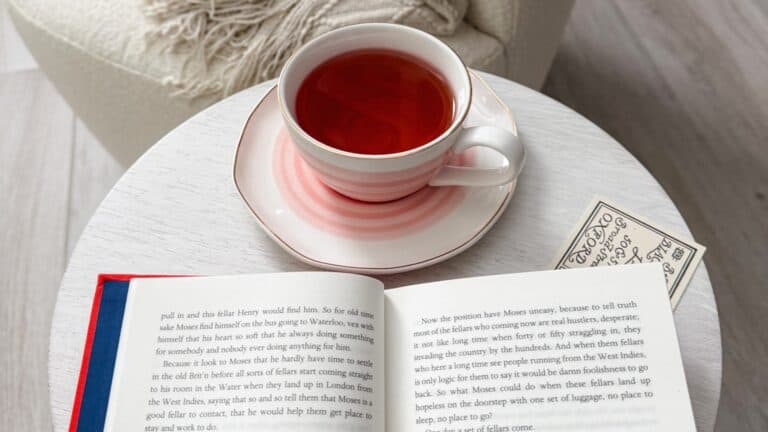
Morning Anchor: “Tea + Two Pages”
Before your day starts asking things of you, you get something that’s just yours.
- Put your book where your mug goes.
- Read two pages while your tea/coffee cools.
- Stop even if it’s getting good. (That’s how you create cravings to return.)
This is the anchor that makes people feel like themselves again.
Midday Anchor: “Audiobook Autopilot”
Choose a daily activity you already do and pair it with audio:
- driving
- walking
- cooking
- laundry
- cleaning
- getting ready
This is how you read on days when your brain feels like mashed potatoes.
Night Anchor: “The Soft Landing”
This is not a productivity routine. This is a nervous-system routine.
Want To Save This Post?
- Put your phone on charge across the room (if possible)
- Read 5-10 minutes in bed
- If you only manage a paragraph, that still counts
Reading at night works best when the book matches your energy (more on that next).
The “Right Book” Matters More Than Motivation
When people tell me they “can’t focus anymore,” nine times out of ten, they’re trying to read the wrong book for the season they’re in.
If you’re overwhelmed, you need books that are:
- easy to re-enter if you get interrupted
- emotionally engaging quickly
- written in clear, immersive prose
- structured in short chapters (or vignettes)
- genuinely enjoyable (not “important” homework)
January energy tip: You’re not behind. You’re recovering. Pick a book that feels like a hand on your shoulder, not a test.
How to Choose Books That Make Reading Feel Easy Again
Pick your current “brain setting”
Choose one:
- Foggy brain: short chapters, cozy pacing, comforting stakes
- Restless brain: page-turners, thrillers, high momentum
- Tender brain: gentle emotional arcs, healing themes
- Scattered brain: essay collections, short stories, linked vignettes
Then choose one book that matches. You don’t need to be in the mood for reading. You need to be in the mood for that book.
Common Questions (Because You’re Not the Only One)
“What if I fall asleep every time I read?”
Perfect. That means reading is calming you down. Switch your night reading to something lighter and keep your deeper books for audio or weekends.
“What if I keep starting books and not finishing?”
Two options:
- Choose shorter books for a month to rebuild confidence.
- Give yourself permission to DNF quickly. Your routine is the win-not the finish line.
“How do I read with kids / a busy household?”
Aim for micro-reads:
- one page at breakfast
- audio while doing dinner
- 5 minutes before bed
You’re not failing. You’re building a life-compatible habit.
My Favorite Books to Help You Rebuild a Reading Routine
These picks are here for one reason: they make reading feel possible again-shorter chapters, emotional pull, and the kind of storytelling that welcomes you back even if you’ve been away for weeks.

Before the Coffee Gets Cold by Toshikazu Kawaguchi
Set in a quiet Tokyo café where customers can travel back in time (with strict rules and a short window), this book follows people trying to make peace with regret, grief, and love. It’s gentle, reflective, and structured in bite-sized stories—perfect when your attention span feels fragile. I’m recommending it because it’s the kind of book you can read in small pockets and still feel emotionally satisfied. For readers who like cozy, wistful, slightly magical fiction, and it left me soft and thoughtful in that “quiet days” way.
You can get a copy of Before the Coffee Gets Cold by Toshikazu Kawaguchi on Amazon.

Vera Wong’s Unsolicited Advice for Murderers by Jesse Q. Sutanto
Vera Wong finds a dead body in her tea shop and decides, naturally, that she must solve the case herself—while collecting a cast of suspects who slowly become her found family. This is one of my favorite “get back into reading” picks because it’s funny, cozy, and keeps momentum without being dark. For readers who like humorous mysteries with heart, and it made me grin the whole way through (plus I wanted tea immediately).
You can get a copy of Vera Wong’s Unsolicited Advice for Murderers by Jesse Q. Sutanto on Amazon.

Days at the Morisaki Bookshop by Satoshi Yagisawa (trans. Eric Ozawa)
After heartbreak and a life wobble, Takako moves into her uncle’s used bookstore in Tokyo’s book district and slowly rebuilds herself—through reading, small routines, and the quiet community that forms around stories. I chose it because it mirrors what so many overwhelmed adults actually need: a gentle reset, not a big reinvention. Perfect for readers who love bookshops, healing arcs, and low-stakes comfort reads, and it made me feel calmer—like my nervous system took a deep breath.
You can get a copy of Days at the Morisaki Bookshop by Satoshi Yagisawa (trans. Eric Ozawa) on Amazon.
Your 7-Day “Make Reading Doable” Starter Plan
If you want something you can start today, here’s the simplest version:
- Day 1: Choose one book + get it in audio + ebook/print
- Day 2: Read 5 minutes (set a timer)
- Day 3: Add an audiobook moment (walk/drive/chores)
- Day 4: Put the book where your coffee/tea goes
- Day 5: Read one page even if you don’t feel like it
- Day 6: Do a “comfort reread” night (something easy)
- Day 7: Choose your next book before you finish this one
That last step matters: nothing kills momentum like finishing a book and not knowing what to read next.
Ready for the gentlest truth?
You don’t need a perfect routine. You need a routine that survives your real life! So if you’ve been overwhelmed, tired, or simply stretched thin, here are some reading tips: start with 10 minutes. Start with audio. Start with one page. That still makes you a reader.
And if you want, tell me what your life looks like right now-commute or no commute, kids or no kids, mornings or nights-and I’ll recommend a reading routine that fits your schedule (plus a couple of book picks that match your current brain setting).