
Halfway Through the Miss Marple Reading Challenge: Favorite Books So Far
Halfway through the Miss Marple Reading Challenge? Explore my reviews of the first six novels, favorite mysteries, reading reflections, and what to read next.
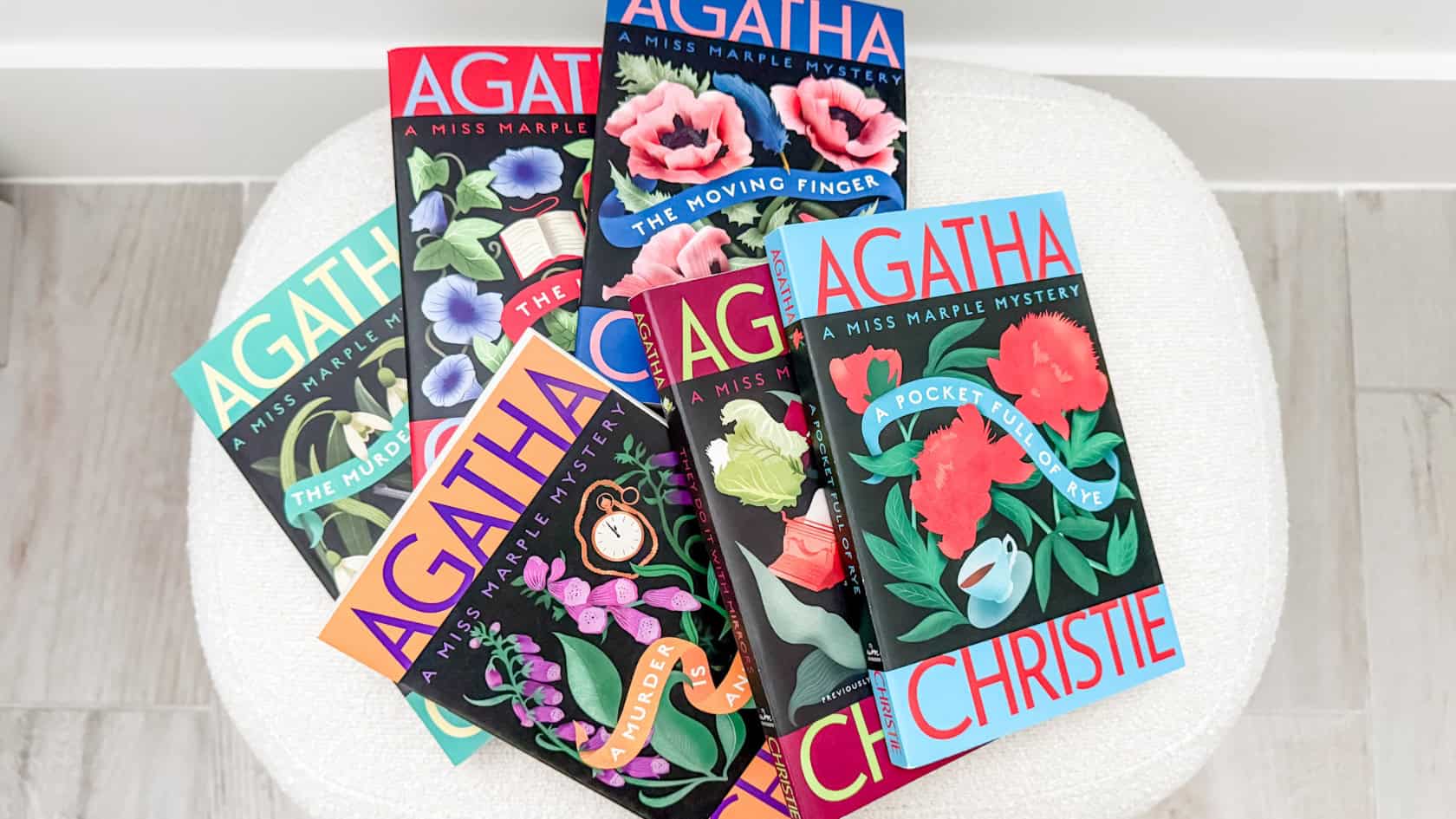
Six Miss Marple Mysteries Later: What I Didn’t Expect From Reading Them in Order
Hi Bookish Besties! If you’ve just finished A Pocket Full of Rye, I have something to tell you. You’ve officially made it halfway through all twelve original Miss Marple novels by Agatha Christie! And I think that deserves a little celebration. Six books. Six very different mysteries. Quite a few suspicious villagers, unhappy marriages, complicated family relationships, and more murders than any respectable English community should reasonably have to deal with.
And through it all, one remarkably observant elderly woman who continues to prove that knowing people can be just as important as knowing the facts. When I first created my Miss Marple Reading Challenge, I thought it would be a lovely way to revisit an author I’ve enjoyed for years and finally give the entire series the attention it deserves. But here’s what I didn’t expect. Reading the Miss Marple novels consecutively has made me appreciate the detective herself just as much as the mysteries she solves.
Instead of remembering only the clever endings, I’m noticing how Christie develops Miss Marple’s personality, how differently she approaches each investigation, and how often the same questions about human nature appear in completely different circumstances. And perhaps most surprisingly, I’ve realized that some of my favorite things about these books have very little to do with identifying the murderer. They’re about friendship, reputation, being underestimated, and the complicated ways people treat one another.

So before we continue with the second half of the series, I wanted to take a little time to reflect on the first six novels, share which ones have impressed me most, and talk about what I’ve learned from spending so much time with Miss Marple. This reflection is completely spoiler-free, so you can read it even if you’re still working through the early books.
And if you’re new to the challenge, welcome! You don’t have to follow a particular calendar or wait for a new year to begin. You can read one Miss Marple novel every week, one every month, or simply whenever you’re in the mood for another mystery. The entire reading order and individual guides are waiting for you in my Miss Marple Reading Challenge Hub.
Halfway Through the Miss Marple Reading Challenge: The First Six Books
We’ve now reached the halfway point in the twelve-novel series, following Agatha Christie’s original publication order. Our first six books take us from The Murder at the Vicarage, published in 1930, to A Pocket Full of Rye, published in 1953. And I think one of the most interesting things about seeing them together is realizing just how varied they are. Christie doesn’t simply introduce Miss Marple in an English village and repeat the same mystery twelve times.
She gives us different narrators, settings, relationships, motives, and investigative structures. Sometimes Miss Marple is involved almost from the beginning. Other times, she barely appears until the final stages of the investigation. But what remains consistent is her extraordinary understanding of people. Before we talk about the bigger themes, I want to revisit each book and share what stood out to me.
And rather than ranking every novel from best to worst, I’m going to focus on the particular things each one does well, along with the aspects that didn’t quite work for me. Because I don’t think every book in a series has to be a favorite to contribute something meaningful to the overall reading experience.
Book 1: The Murder at the Vicarage (1930)
We began our journey in St. Mary Mead, where the thoroughly unpopular Colonel Protheroe is discovered murdered in the local vicarage. And almost immediately, we’re introduced to the quality that makes Miss Marple such an extraordinary detective. She understands people. She knows who’s likely to exaggerate, who’s hiding something, and how quickly ordinary gossip can turn into apparently convincing evidence.
One thing I particularly enjoyed about The Murder at the Vicarage was the decision to tell the story through Reverend Leonard Clement rather than Miss Marple herself. It means we get to discover her abilities gradually, much as the other characters do. At first, she appears to be another elderly villager with an interest in everyone’s private affairs. But as the investigation develops, it becomes increasingly clear that her observations are considerably more useful than the police initially realize.
I also loved meeting Griselda Clement, whose unconventional personality brings some welcome humor to the story. For me, the greatest pleasure of this novel is the world Christie creates rather than the actual murder puzzle. The solution is clever, but it didn’t excite me quite as much as some of the mysteries that followed. Still, I can’t imagine beginning our challenge anywhere else.
What stayed with me: Miss Marple doesn’t need to dominate a conversation to understand what’s happening. She’s perfectly content to observe while everyone else underestimates her.
Read my full guide: The Murder at the Vicarage
Book 2: The Body in the Library (1942)
I have to admit, this is where the challenge really grabbed me. There’s something irresistible about the idea of a respectable country household waking up to discover an unknown young woman’s body in the library. It’s such a wonderfully Christie premise. The situation is almost comical until you remember that someone has actually been murdered. And once the investigation begins, the mystery becomes increasingly complicated.
One of the things I appreciated most about The Body in the Library was the contrast between the traditional world of Gossington Hall and the fashionable seaside hotel where the victim worked. Christie uses those different environments to explore how much our opinions of other people depend on appearances. Someone may be considered respectable because of their social position. Another person may be treated with suspicion because of their occupation, clothing, or relationships.
And sometimes those assumptions have very little to do with the truth. But what I found especially interesting was Miss Marple’s motivation. Dolly Bantry isn’t simply worried about having a murder to explain. She’s concerned about what the scandal could do to her husband’s reputation. And Miss Marple recognizes that an innocent person can suffer enormously even without being formally accused of a crime. I think that’s such an important part of her character.
She’s interested in solving murders, certainly. But she’s also interested in protecting people from injustice. For me, this is one of the strongest books in the first half of the challenge. The opening is fantastic, the pacing is engaging, and the final explanation rewards close attention.
What stayed with me: Sometimes the most important question isn’t who looks suspicious, but why everyone is so willing to believe a particular story.
Read my full guide: The Body in the Library
Book 3: The Moving Finger (1942)
Of our first six novels, The Moving Finger is probably the one that feels most different from what people imagine when they think of Miss Marple. For one thing, she doesn’t appear until quite late in the story. Instead, we spend much of the novel following Jerry Burton and his sister Joanna as they settle into the seemingly peaceful village of Lymstock. But their quiet new life becomes increasingly uncomfortable when anonymous letters begin arriving, accusing the residents of all sorts of scandalous behavior.
What I find so interesting about this book is the way Christie creates tension without immediately relying on murder. The letters themselves begin changing how people behave. Neighbors become suspicious. Ordinary relationships are questioned. And even accusations that seem obviously false begin causing real harm. It’s difficult to read this novel without thinking about how easily similar things happen today. We may not receive anonymous poison-pen letters in the post, but rumors and accusations can still spread with very little evidence.
And once people begin repeating something, it becomes surprisingly difficult to undo the damage. I also found Megan Hunter’s storyline particularly interesting, especially the way people underestimate her because she doesn’t fit their expectations of how a young woman should behave. This isn’t necessarily one of my favorite Christie mysteries in terms of the actual puzzle, and I would have enjoyed spending more time with Miss Marple. But I think it’s one of the more thought-provoking books we’ve read.
What stayed with me: A rumor doesn’t have to be true to hurt someone, and respectability doesn’t necessarily make a person’s judgment reliable.
Read my full guide: The Moving Finger
Book 4: A Murder Is Announced (1950)
If someone asked me which of our first six novels best demonstrates Agatha Christie’s ability to construct an elaborate mystery, I think A Murder Is Announced would be my answer. The premise alone is brilliant. A newspaper advertisement announces that a murder will take place at a particular house on a particular evening. And naturally, the villagers decide to turn up and see what happens. Honestly, I still find their collective curiosity hilarious.
But once the lights go out and the supposed entertainment becomes a real crime, Christie begins revealing just how carefully the mystery has been arranged. This is one of those books where the seemingly ordinary details become increasingly impressive after you’ve finished reading. A household object. A casual remark. Someone remembering something incorrectly. All those little observations that initially seem unimportant eventually contribute to the solution.
I also think the novel offers a fascinating glimpse into postwar England. People have moved, families have changed, and individuals are establishing new lives in communities where their histories aren’t always known. That uncertainty becomes particularly important in a mystery about identity. But what surprised me most was how emotional parts of the story became. Bunny Bunner, in particular, is a character whose apparent forgetfulness makes it easy for the other residents to dismiss her.
And I think Christie uses that beautifully to explore what happens when we assume someone has nothing valuable to contribute. For me, A Murder Is Announced is one of the most satisfying mysteries we’ve encountered so far, particularly because its solution makes you reconsider so many details from the beginning.
What stayed with me: Christie doesn’t always hide the evidence. Sometimes she simply encourages us to interpret the evidence incorrectly.
Read my full guide: A Murder Is Announced
Book 5: They Do It with Mirrors (1952)
This is probably the book that challenged my enthusiasm the most during the first half of the series. And I don’t mean that it’s a bad mystery. There’s a genuinely clever idea at the center of They Do It with Mirrors, particularly the way Christie uses a dramatic confrontation to direct everyone’s attention away from what matters. But compared with A Murder Is Announced, I found the overall mystery a little less satisfying.
The setting is unusual: Stonygates, a sprawling country estate that also serves as a rehabilitation center for young offenders. We’re introduced to Carrie Louise Serrocold, an old friend of Miss Marple, and a household filled with complicated relationships, charitable ambitions, and people who have very different opinions about one another. What I found most interesting wasn’t necessarily the murder itself. It was the question of what happens when someone becomes so devoted to a particular cause that they stop questioning their own decisions.
Christie explores philanthropy, family obligations, emotional manipulation, and the difference between appearing to do good and actually behaving well. I also enjoyed learning more about Miss Marple’s younger years through her friendship with Carrie Louise and Ruth Van Rydock. It’s easy to think of Miss Marple only as the elderly woman quietly gardening in St. Mary Mead, so I appreciate the moments when Christie reminds us that she has an entire history of her own.
While I wouldn’t place this book among my favorites, I do think its central illusion is memorable. And that’s one of the pleasures of reading the complete series. Not every mystery will be equally successful for every reader. But even the books we enjoy less can give us something interesting to think about.
What stayed with me: A person can genuinely believe they’re doing good while making choices that hurt the people around them.
Read my full guide: They Do It with Mirrors
Book 6: A Pocket Full of Rye (1953)
And then we reached A Pocket Full of Rye. I think this is one of the darker novels in the first half of the series, and it left me appreciating Miss Marple in a completely different way. The mystery begins when wealthy businessman Rex Fortescue suddenly dies, and investigators discover grains of rye in his pocket. Before long, the crimes appear to be connected to the nursery rhyme “Sing a Song of Sixpence.” On the surface, it’s a wonderfully clever idea.
A childhood rhyme transformed into the structure of a murder mystery. But underneath that apparently playful pattern is a deeply unpleasant family where greed, resentment, and entitlement influence almost every relationship. The Fortescues have money, an impressive house, and all the material comforts anyone could reasonably want. Yet there’s remarkably little affection among them. And I think that’s what makes the atmosphere so unsettling.
But what really stayed with me was Miss Marple’s emotional involvement. Without spoiling the mystery, she has a personal connection to someone affected by the crimes, and that connection makes the investigation far more than an intellectual exercise. We see a side of her that isn’t simply interested in discovering who committed murder. She’s angry about the way someone vulnerable has been treated. And she’s determined to make sure the truth is known.
I think that makes this novel an important turning point in how I understand her character. Miss Marple isn’t simply clever. She has a powerful sense of justice. And sometimes, beneath that gentle manner, she’s positively formidable.
What stayed with me: Understanding human nature also means recognizing when someone has used another person’s trust against them.
Read my full guide: A Pocket Full of Rye
My Favorite Miss Marple Books From the First Half of the Challenge
Now, I know this is probably the part everyone wants to discuss. Which books have been my favorites so far? I’ve deliberately avoided assigning a strict ranking to every novel because I think each one offers something different. And my feelings about a book can change depending on what I’m paying attention to during a particular reading. But after finishing these six, there are definitely a few standouts.
The Most Satisfying Mystery: A Murder Is Announced
If we’re talking about the actual construction of a murder mystery, I think A Murder Is Announced is particularly impressive. The opening is irresistible, the clues are carefully placed, and the eventual explanation makes you appreciate how deliberately Christie arranged the entire story. I love a mystery that makes me want to go back and reread the beginning. And this one absolutely does.
The Book That Hooked Me Fastest: The Body in the Library
There’s something wonderfully entertaining about this novel from the moment the maid announces what’s been discovered downstairs. I love the contrast between the respectable country-house setting and the completely outrageous situation. And once the investigation expands beyond Gossington Hall, I think the story becomes even more engaging. If someone wanted an accessible, entertaining introduction to the kind of mystery Christie does so well, this would be one of my recommendations.
The Book That Made Me Appreciate Miss Marple Most: A Pocket Full of Rye
This is the one that left the strongest emotional impression on me. Not necessarily because the mystery is the most complicated, but because Miss Marple’s personal involvement reveals something important about her. She’s observant, patient, and intelligent. But she’s also compassionate. And when someone exploits another person’s vulnerability, her determination to see justice done is something I find deeply admirable.
The Most Thought-Provoking: The Moving Finger
If I’m thinking about the story that feels surprisingly relevant to modern life, I’d choose The Moving Finger. Its exploration of gossip, anonymous accusations, and the way communities decide whom to believe is genuinely unsettling. Even though Miss Marple has a relatively small role, the questions Christie raises about reputation and social judgment have stayed with me. And I think that’s a good reminder that the books we find most thought-provoking aren’t always the ones we consider our favorites.
What Reading Six Miss Marple Novels Has Taught Me About Her Character
Before beginning this project, I thought I already understood Miss Marple pretty well. She’s observant. She knows everything about St. Mary Mead. And people constantly underestimate her. All true. But after spending six novels with her, I think there’s considerably more to appreciate.
She Understands That People Rarely Behave in Entirely New Ways
One of Miss Marple’s most distinctive habits is comparing the people involved in a mystery with people she’s known throughout her life. At first, those village anecdotes can seem like amusing distractions. Someone reminds her of a shopkeeper. Another behaves like a former neighbor. And suddenly she’s explaining an event from decades earlier that appears to have absolutely nothing to do with the investigation. But we’ve now seen enough of her methods to recognize that those stories aren’t random.
She’s identifying a pattern. People may live in different circumstances, but jealousy, greed, vanity, resentment, and the desire for affection can influence behavior in remarkably similar ways. And Miss Marple knows how to recognize those similarities. I think there’s something fascinating about that approach to solving mysteries. She doesn’t need every person to be completely unique. She needs to understand the familiar motives beneath their behavior.
She Doesn’t Confuse Being Respectable With Being Good
This is one of the things I admire most about her. Miss Marple has lived long enough to understand that having a respectable job, a beautiful home, or an impressive reputation doesn’t automatically make someone kind or trustworthy. And she doesn’t assume that a person with less money, less education, or less social standing is necessarily less credible. That’s especially important in these early novels, where social expectations influence how people interpret nearly every crime.
A wealthy man may be treated with respect despite behaving terribly. A young woman may be judged harshly because of her appearance. And a servant’s observations may be dismissed simply because of her position in the household. Miss Marple understands how misleading those assumptions can be. And I think that’s one reason her methods remain so satisfying to read.
Her Kindness Isn’t the Same Thing as Being Naive
Another thing I’ve begun appreciating is how Christie balances Miss Marple’s gentle manner with her understanding of human cruelty. She’s perfectly capable of enjoying ordinary village life. She values friendships, familiar routines, and the small comforts of home. But she doesn’t imagine that everyone around her is harmless. In fact, she often expects people to behave badly because she’s seen enough examples of it throughout her life.
What interests me is that she doesn’t allow that knowledge to make her indifferent. She’s still concerned about innocent people. She still recognizes when someone needs help. And as we see particularly clearly in A Pocket Full of Rye, she’s deeply affected when someone vulnerable is treated cruelly. I think that’s a much more interesting combination than simply being a clever elderly detective.
She Shows Us That Experience Has Value
I think this may be my favorite lesson from the first six books. Miss Marple is regularly underestimated because of her age and appearance. People see a woman who enjoys gardening, knitting, and discussing village affairs. And they assume she couldn’t possibly understand the important details of a criminal investigation. But those ordinary interests are precisely what have helped develop her understanding of people. She’s spent years paying attention.
She’s listened to conversations. She’s observed how people behave when they’re disappointed, jealous, frightened, or trying to impress someone. And those experiences have taught her something that isn’t always available through professional training. I love that. Especially because I think we sometimes underestimate the value of knowledge gained through ordinary life. Not every useful skill comes with a qualification.
Not every intelligent person feels the need to demonstrate it constantly. And not everyone who speaks confidently understands what they’re talking about. Miss Marple reminds me that quiet observation can be a remarkable strength.
My Biggest Surprise: These Books Don’t All Follow the Same Formula
Before reading the novels consecutively, I think it was easy to remember them as variations on the same comforting idea. An English village. A murder. A group of suspicious people. And Miss Marple patiently working out what happened. But now that we’ve finished six, I’m realizing how much variety Christie introduces.
We’ve had a traditional village murder in The Murder at the Vicarage, a glamorous young woman discovered in a library, a community tormented by anonymous letters, a crime announced in advance, an elaborate illusion at a country estate, and a series of murders connected to a nursery rhyme. And even Miss Marple’s involvement changes from book to book. Sometimes she’s present for much of the investigation. Other times, she appears late and helps the police recognize what they’ve overlooked.
Sometimes she’s investigating because a friend asks for help. And sometimes the crime affects her personally. I think that’s what makes reading an entire series such a rewarding project. You begin recognizing the differences as much as the similarities. And while we may develop favorite settings or types of mysteries, there’s something wonderful about discovering that the next book might offer a completely different experience.
What I’ve Enjoyed About Reading These Books as a Challenge
One of the things I wanted from this project was an excuse to spend more time with an author whose books I’ve enjoyed for years. But I didn’t want it to become another obligation. I already have plenty of books on my reading list, and I know how easy it can be to turn an enjoyable hobby into something that feels like work. That’s why I love the idea of a reading challenge where you can choose your own pace. You might spend six weeks reading the first six novels.
You might take six months. Or perhaps you’ve been working through them slowly over several years. I think all of those approaches are equally worthwhile. What matters is that you’re taking the time to enjoy the books. And personally, I think there’s something especially satisfying about having a familiar author to return to between other reading interests. When you’re not sure what you’re in the mood to read next, there’s comfort in knowing that another Christie mystery is waiting.
I also love the way a project like this allows you to develop your own opinions. You don’t have to agree with the most popular rankings. You don’t have to love every book. And you certainly don’t have to finish a mystery feeling as though you should have guessed the murderer. Sometimes the pleasure is simply spending a few hours with an interesting story. And sometimes a book gives you something to think about long after you’ve forgotten the details of the plot. I think that’s a lovely outcome either way.
A Little Halfway Reading Challenge Check-In
If you’ve finished the first six books, I would encourage you to take a moment and think about what you’ve enjoyed so far. Not because you need to write a formal review or complete an assignment. But because I think reflecting on our reading helps us understand our own tastes. Maybe you’ve discovered that you prefer Christie’s elaborate puzzle mysteries to her slower psychological stories. Perhaps you love the village settings but aren’t as interested in the larger country-house investigations.
Or maybe you’ve realized that the books which stay with you aren’t necessarily the ones with the most surprising endings. I think those observations are worth paying attention to. And if you’re using the printable tracker from my reading challenge, this would be a lovely moment to mark your progress and see how far you’ve come. Six books finished. Six more to enjoy. And absolutely no need to rush.
If you’d like the free tracker, you can find it through my Miss Marple Reading Challenge Hub, along with every novel and its accompanying spoiler-safe reader guide.
What Are the Next Six Miss Marple Books?
Now for the exciting part. We still have six original Miss Marple novels ahead of us, and there are some wonderful changes of scenery coming. Here’s what you can look forward to as you continue the challenge.
Book 7: 4.50 from Paddington (1957)
Our next mystery begins with one of Christie’s most irresistible scenes: a woman witnesses a murder through the window of a passing train, but nobody can find the body. I particularly enjoy this novel because it introduces the wonderfully capable Lucy Eyelesbarrow, whose practical intelligence makes her an excellent partner in Miss Marple’s investigation.
Read the next guide: 4.50 from Paddington
Book 8: The Mirror Crack’d from Side to Side (1962)
We’re returning to St. Mary Mead, but this time a famous actress has moved into the neighborhood, bringing a little Hollywood glamour with her. When a murder occurs during a charity event, the investigation becomes a fascinating exploration of celebrity, memory, and grief. I think this is one of Christie’s most emotionally interesting Miss Marple novels.
Book 9: A Caribbean Mystery (1964)
Miss Marple is heading somewhere completely different: a tropical holiday resort in the Caribbean. But naturally, a relaxing vacation doesn’t prevent her from encountering suspicious people and an unexplained death. I love the contrast between Miss Marple’s familiar detective methods and the unfamiliar setting, particularly her unexpected relationship with Mr. Rafiel.
Book 10: At Bertram’s Hotel (1965)
If you love atmospheric settings, I think you’ll enjoy visiting Bertram’s Hotel, an elegant London establishment that seems to have preserved the charm of an earlier era. But underneath its impeccable service and old-fashioned comforts are some very modern secrets. This one raises interesting questions about nostalgia and whether the past is ever quite as wonderful as we remember.
Book 11: Nemesis (1971)
Miss Marple receives a mysterious assignment from someone who trusted her judgment, but she isn’t initially told exactly what she’s supposed to investigate. I think this becomes particularly meaningful after reading A Pocket Full of Rye, because we already understand how strongly she feels about justice and the importance of correcting a wrong.
Book 12: Sleeping Murder (1976)
Our final novel takes us to a seaside house where a young woman’s unsettling childhood memories begin suggesting that something terrible happened years earlier. It’s an atmospheric mystery about the past refusing to remain buried, and I think it provides a wonderfully eerie conclusion to the twelve original novels.
After those six books, you’ll also have the option of continuing with Agatha Christie’s twenty original Miss Marple short stories, which I’ve organized into two bonus reading guides. You don’t need to think about those just yet. For now, we have six more novels to enjoy. And if you’d like to see the full reading order, you can always return to the Miss Marple Reading Challenge Hub.
Let’s Talk About Our Favorite Miss Marple Books So Far
Now that we’ve reached the halfway point, I really want to hear your opinions. Because one of my favorite things about reading is discovering how differently people respond to the same story. A mystery I love for its elaborate puzzle might be someone else’s least favorite because they prefer a slower, more character-driven investigation. And a book that didn’t completely work for me might become your absolute favorite. That’s part of what makes these conversations so interesting. So here’s what I’d love to know.
Our Halfway Book Club Discussion Questions
- Which of the first six Miss Marple novels is your favorite, and what made it stand out? Was it the mystery, the atmosphere, the characters, or something else?
- Which book surprised you most? Maybe you loved one you hadn’t expected to enjoy, or perhaps a famous mystery didn’t quite live up to your expectations.
- Has your opinion of Miss Marple changed since The Murder at the Vicarage? Is there something about her character you appreciate more now than you did at the beginning?
- Which kind of Christie mystery do you prefer so far? The tightly constructed puzzles of The Body in the Library and A Murder Is Announced, or the more psychological stories like The Moving Finger?
- If you could recommend just one of these six books to a friend who has never read Miss Marple, which would you choose?
You don’t need to answer every question. I’d be perfectly happy with a comment telling me your favorite book and why you loved it. And if you haven’t reached Book 6 yet, you’re welcome to share whichever mystery you’re currently reading. I especially love hearing from readers who are experiencing these books for the first time. Because there’s something so enjoyable about seeing someone discover a classic mystery that has entertained readers for generations.
Ready for the Second Half of the Miss Marple Reading Challenge?
If you’ve made it to this point, congratulations again. We’ve read six wonderful, complicated, occasionally unsettling mysteries, and we’ve learned quite a lot about one of literature’s most beloved detectives. We’ve seen Miss Marple recognize patterns in human behavior, challenge accepted explanations, protect innocent people from suspicion, and demonstrate that being underestimated can sometimes be an advantage. And I think the most important thing I’ve taken from these books is that paying attention matters.
To people. To the small details of ordinary life. To the things someone says when they think nobody is listening. And perhaps most importantly, to the people whose voices are most easily overlooked. I love a clever mystery, and Agatha Christie certainly knows how to write one. But I’m beginning to think that what I’ll remember most about this challenge isn’t necessarily the murders. It’s Miss Marple herself. Her patience, her confidence, and her remarkable understanding of people.
And I can’t wait to see what the next six novels reveal about her. If you’re ready to continue, our next book is 4.50 from Paddington, where a murder witnessed from a moving train creates one of Christie’s most memorable mysteries.
Continue reading: 4.50 from Paddington
Or bookmark my Miss Marple Reading Challenge Hub so you can return for your next mystery whenever you’re ready. And don’t forget to leave a comment telling me your favorite Miss Marple novel from the first half. I have a feeling we’re going to have some very different opinions, and honestly, that’s half the fun. Happy reading, bookish besties. I’ll see you in St. Mary Mead!



I love Miss Marple! Have read her over and over. My favorite is Nemesis. I also liked A Murder is Announced, Murder at the Vicarage, and a Pocket Full of Rye. She is the best.
I love hearing this! Nemesis is such a great favorite, and you named several of the ones I’ve really enjoyed revisiting too. There’s just something so satisfying about Miss Marple, and I feel the more you read her, the more you appreciate how observant and quietly brilliant she is. She really is the best!