A Simple Beginner’s Guide on How to Start Letter Writing
Learn how to start letter writing with this simple beginner’s guide to supplies, what to write, mailing letters, finding pen pals, and making it a habit.
Want to Start Writing Letters? Here’s How I’d Begin
Hi Besties, I’ve always been a letter writing and card person. I write to family and friends. When I travel, I’m the person who will actually carve out time to find a postcard, write something on it, hunt down a stamp, and put it in the mail instead of simply texting everyone a photo. There is something about a physical message that feels different to me. Someone sat down. They chose the words. They wrote them by hand. They put the letter in an envelope, addressed it, and sent this little piece of their day across the world to somebody else. I love that. And the more our communication has moved toward quick messages, notifications, reactions, and things we read once before they disappear up a screen, the more I’ve come to value letter writing. I don’t think everything meaningful needs to be efficient. Actually, I think part of what makes a handwritten letter meaningful is that it isn’t. So if you’re wondering how to start letter writing, I want to make this incredibly easy. You don’t need beautiful handwriting, expensive stationery, or fascinating stories to tell. You need paper, a pen, someone to write to, and enough time to say what you actually want to say. That’s where I would begin.
How to Start Letter Writing in 5 Simple Steps
If you’ve landed here because you want the practical answer first, this is it:
- Choose someone to write to. Start with a friend, family member, or someone you already communicate with.
- Grab paper and a pen. Regular notebook paper is perfectly acceptable.
- Write like you’re talking to them. Tell them what you’ve been doing, something you’ve been thinking about, or why you wanted to write.
- Close with a question or kind thought. Give them something they can respond to.
- Put it in an envelope and mail it. If you’re not ready to send it, that’s okay too.
Your first letter does not have to be profound, it just has to exist.
Why I Think Letter Writing Is Worth Bringing Back
I’m not anti-texting. I text. I send voice notes. I email. I send things to people because they reminded me of them. But I don’t think those things replace letters. They’re different forms of connection. A text usually belongs to the moment. A letter can become an object someone keeps. I’ve found old cards and letters tucked into drawers and books years after I received them, and I never react to those the same way I react to finding an old text message. There’s handwriting. There’s the paper or card someone chose. There’s sometimes a date in the corner. There might be a coffee stain, a crossed-out word, or a sentence squeezed into the margin because the writer thought of one more thing they wanted to tell you. That’s part of why I love it. A handwritten letter carries evidence of the person who wrote it. And I think we could use more communication that feels like someone was actually there.
What You Need to Start Writing Letters
This is where stationery can become dangerous. You start by thinking, “I’d like to write my friend a letter.” Three hours later, you’re comparing fountain pen inks and personalized wax seals as though you’ve been appointed royal correspondent. You do not need all of that. At least not yet.
Paper
Any paper you can comfortably write on works. That includes:
- plain writing paper
- lined notebook paper
- stationery
- notecards
- greeting cards
- postcards
I love beautiful stationery, but beautiful stationery is an enhancement, not an entrance fee. So please, use what you have first.
A Pen
Choose a pen that feels comfortable in your hand and doesn’t make writing annoying. That’s my entire pen philosophy for beginners. You can explore fountain pens, colored inks, brush pens, and all the lovely extras later if letter writing becomes something you genuinely enjoy.
An Envelope
If you’re mailing your letter, you’ll need an envelope large enough to hold it without creating a complicated paper-engineering situation. If you’re using a greeting card or stationery set, it may already come with one.
A Mailing Address
Ask your recipient for their current mailing address rather than assuming the one you saved six years ago is still correct. Trust me.
Postage
If you’re mailing the letter, you’ll also need the correct postage for its destination, size, shape, and weight. A normal letter is straightforward, but unusual envelopes, heavier letters, and international mail may require different postage. If I’m unsure, I’d rather check with my postal service than play the exciting game of Will This Letter Ever Arrive?
Who Should You Write Your First Letter To?
I think beginners sometimes make this harder by immediately trying to find a pen pal. You can. But you don’t need one. I would start with someone you already care about.
Write to a Friend
This is probably the easiest first letter because you already have a conversational rhythm. Tell them you’ve decided to try writing letters. Talk about something you’ve been doing. Mention a book, show, meal, place, or ridiculous little thing that reminded you of them. Then ask what’s happening with them. That’s a letter.
Write to a Family Member
Parents, grandparents, siblings, cousins, nieces, nephews; anyone you’d enjoy surprising with something in their mailbox. I especially like writing to people I don’t see regularly because a letter gives me room to share more than the usual “How are you?” exchange.
Write to Someone You Want to Thank
A thank-you letter is one of the easiest ways to begin because you already know the purpose.
- Tell them what they did.
- Tell them why it mattered.
- Tell them you’re grateful.
I’ve written more about this in my guides to meaningful ways to say “I appreciate you” and creative ways to thank a friend if you need help finding the words.
Write to Yourself
Yes, this counts. Write to yourself one year from now. Write about what you’re reading, what you’re excited about, what your ordinary days currently look like, or what you hope Future You remembers about this season. Seal it. Add a date when you’re allowed to open it. I love the idea of creating a tiny time capsule with words.
Find a Pen Pal
If you enjoy your first few letters and want to correspond with someone new, then I would explore pen-pal communities. I’ve personally used Geek Girl Pen Pals successfully, and I like that pen-pal correspondence gives letter writing a rhythm: write, send, wait, receive, respond. That waiting is part of the experience. Just use normal internet-safety judgment when exchanging personal contact information with someone you don’t know.
What Do You Write in a Letter?
This is probably the question I hear underneath “how do I start letter writing?” Because supplies are easy. The blank page is intimidating. My best advice is this: Stop trying to sound like someone who writes letters, just write like yourself. You’re not auditioning to become a nineteenth-century novelist. You don’t need to begin with, “My dearest Margaret, I trust this correspondence finds you in excellent spirits.” Unless that’s genuinely how you speak, in which case, please carry on. And truthfully, that was the way I was taught in school. But instead I want you to think of the person sitting across from you. What would you tell them? Write that.
What to Write in Your First Letter
If you need prompts, these are the kinds of things I naturally include:
- something that’s happened since we last talked
- what I’m currently reading
- a funny or strange thing I noticed
- something that reminded me of them
- a place I’ve recently visited
- what I’ve been cooking or baking
- something I’m looking forward to
- a shared memory
- a recommendation
- a question I’ve been meaning to ask
- something I appreciate about them
The ordinary things are often what make letters good. So you don’t need breaking news from your life. Instead, tell me about the bookstore you wandered into. Tell me the cake went terribly wrong. Tell me your neighbor’s cat has apparently decided your porch belongs to him now. Tell me you finally read the book we talked about six months ago and you have thoughts. That is life. And that’s what I want in a letter.
A Simple Letter-Writing Format for Beginners
If having a structure makes the blank page less intimidating, use this one.
1. Add the Date
I always recommend dating your letters. I know it might seem unimportant now or incredibly old fashioned. But it becomes incredibly important if someone finds that letter years later.
2. Start With a Greeting
- “Dear Sarah,” works.
- “Hi Mom,” works.
- “Hello from my kitchen table,” works.
Use whatever sounds like you.
Want To Save This Post?
3. Open With Why You’re Writing
You can make this wonderfully simple:
- “I’ve been meaning to write to you.”
- “I saw something yesterday that reminded me of you.”
- “I’m trying to get back into writing actual letters.”
- “I realized it has been far too long since I sent you something that wasn’t a text.”
There. You’re already writing.
4. Share Two or Three Things
Think of these as more conversational threads. Maybe one is an update, one is a story, or one is something you’ve been thinking about. You don’t have to cover your entire life.
5. Ask Something
Letters become conversations when you leave openings for the other person.
- Ask what they’re reading.
- Ask how something turned out.
- Ask what they’re looking forward to.
- Ask whether they’ve watched the show you recommended.
6. Close Naturally
- “Love,”
- “Thinking of you,”
- “Write back soon,”
- “With love,”
- “Until next time,”
Or simply your name. Again, we’re not being graded.
An Easy First-Letter Formula I Actually Use
If you’re still staring at the page, remember this: Hello + update + story + question + kind closing.
That’s it. For example, you might start by saying you’ve wanted to write for a while. Share what you’ve been doing lately. Tell a small story about something that happened this week. Ask what they’ve been up to. End by telling them you hope to hear from them soon. One page is enough. Half a page is enough. A postcard with four sentences is enough. I would much rather receive a short genuine note than a six-page letter someone hated writing.
How to Address and Mail a Letter
This part can make letter writing feel more complicated than it is, especially if you haven’t mailed anything in years. For a standard letter, you’ll generally put the recipient’s mailing information on the front of the envelope, include your return address, add the appropriate postage, and then place it in outgoing mail or take it to the post office. The exact formatting and postage requirements can vary by country and by what you’re mailing, so I always recommend checking your postal service’s current guidance if you’re uncertain, especially for international letters, oversized envelopes, or anything unusually heavy. And before sealing the envelope? Make sure the actual letter is inside. I will not elaborate on why this deserves its own reminder.
How Long Should a Personal Letter Be?
As long as it needs to be. I don’t have a word-count rule for friendship. Some letters are several pages because I have a lot to say. Some are one page. Some are postcards where I’m trying to fit an entire thought into a tiny rectangle while leaving room for the address and stamp. The length isn’t what makes it meaningful. If you said what you wanted to say, you’re finished.
Your Handwriting Does Not Need to Be Beautiful
I want to specifically address this because beautiful handwritten correspondence online can make letter writing look like calligraphy practice. Your handwriting only needs to be reasonably readable. That’s it. Cross things out. Squeeze forgotten words into sentences. Change pens halfway through. Draw an arrow because you remembered something that belongs three paragraphs ago. Those imperfections are part of what makes a handwritten letter feel handwritten.
How I Make Letter Writing Feel Like a Ritual
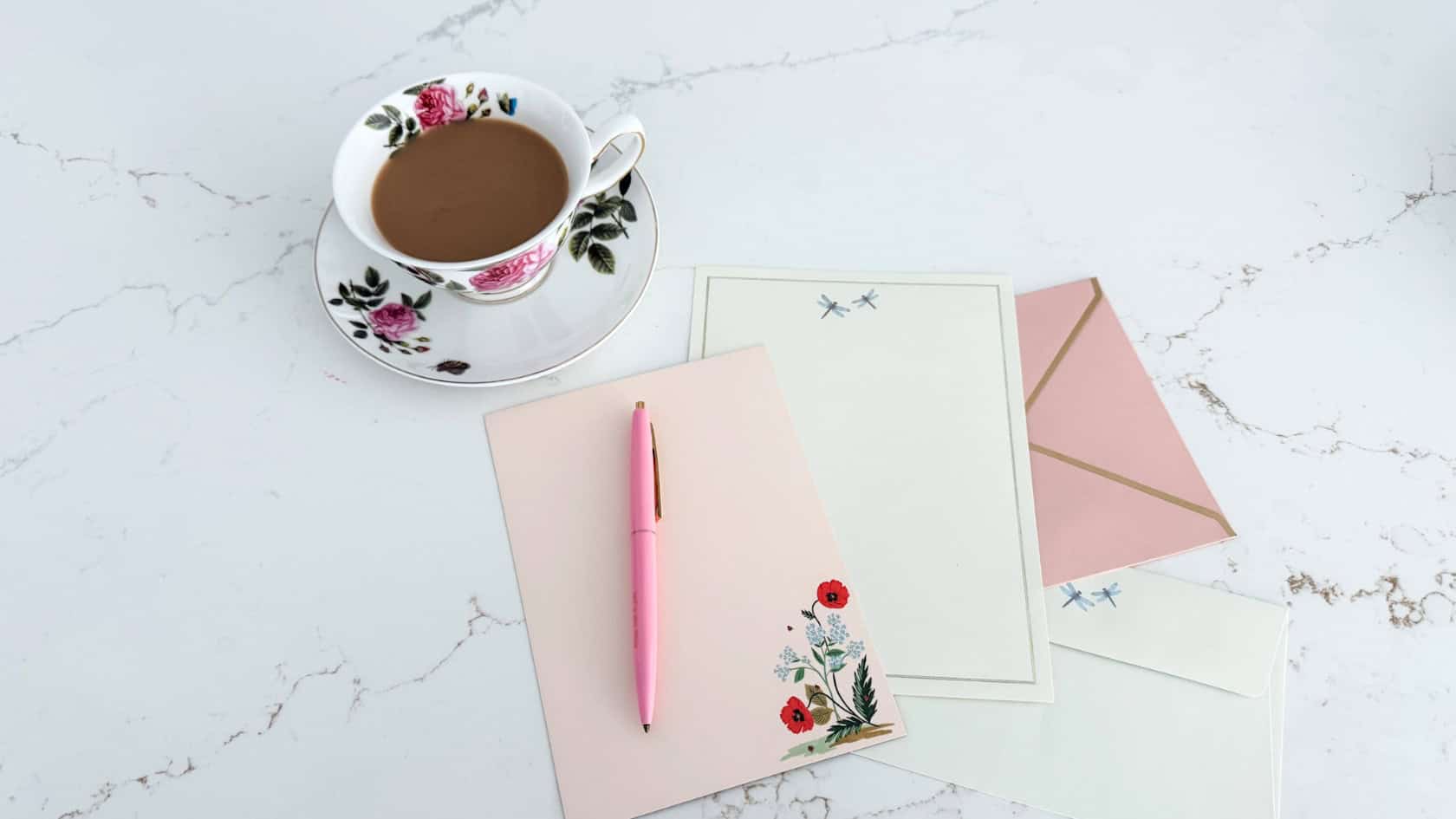
This is where letter writing moves from “something I should do” into something I actually want to do. I like making a little space for it.
- A cup of tea or coffee.
- A comfortable place to sit.
- My paper.
- A pen I enjoy using.
- Maybe music.
- Maybe silence.
Then I put my phone somewhere that isn’t constantly asking for my attention. I’m not trying to manufacture a perfect cozy moment. I just want to make enough room to concentrate on one person and one conversation. That’s increasingly rare. And I think that’s part of why it feels so good.
You Don’t Need to Buy an Entire Stationery Collection
Do I understand the appeal of beautiful stationery? Deeply. Do you need twelve sets before writing your first letter? You do not. I would treat letter writing the same way I treat any new affordable hobby for relaxation: start with what you already have, see whether you actually enjoy doing it, and then slowly add things that make the experience better. Once you know you love writing letters, you might enjoy collecting:
- stationery
- postcards
- stamps
- stickers
- washi tape
- fountain pens
- ink
- address labels
- wax seals
But those things are the accessories. The letter is the hobby.
How to Make a Letter Feel More Personal
This is where I have fun. The words matter most, but you can add little touches without turning the letter into an elaborate craft project.
Tuck Something Small Inside
- A bookmark.
- A little drawing.
- A recipe.
- A photograph.
- A pressed flower where mailing rules allow it.
- A tiny reading list.
Something flat and simple can make opening the envelope feel even more special.
Recommend a Book
You knew I was going to say this. If I’ve read something I think the recipient would love, a letter is the perfect place to tell them why. Not just, “Read this.” Tell them, “This character reminded me of that conversation we had,” or “I think this has exactly the kind of atmosphere you love.” That feels much more personal.
Decorate the Envelope
You can add stickers, drawings, stamps, or little flourishes. Just make sure anything decorative doesn’t interfere with the address, postage, or postal markings.
Include Something Only the Two of You Understand
- An inside joke.
- A nickname.
- A shared memory.
- A reference nobody else would understand.
That’s the stuff that turns stationery into your correspondence.
How to Turn Letter Writing Into a Hobby You Actually Keep
I think the secret is resisting the temptation to make it bigger than it needs to be.
- Keep your supplies together. A small box or drawer with paper, envelopes, stamps, cards, and your favorite pens means you can sit down and begin without hunting for everything. Keep a few addresses somewhere accessible.
- Write when you genuinely have something to say.
- And give yourself permission to send postcards and cards when a full letter feels like too much.
- I also love connecting letter writing to things I’m already doing.
- Traveling? Send a postcard.
- Finished a book a friend recommended? Write and tell them.
- Thinking about someone? Send a card.
- Want to thank somebody? Don’t wait for a special occasion.
Letter writing becomes much easier when it belongs to your existing life instead of sitting outside it as another hobby you need to “make time” for.
My Favorite Reason to Write a Letter: Give Someone Something to Keep
This is ultimately what separates letters from most of my everyday communication. A letter can stay. Someone can tuck it into a box. Use it as a bookmark. Find it in a drawer years later. Recognize your handwriting before they’ve even read your name. I genuinely love that. I’m not interested in bringing back letter writing because I think everything old is automatically better. I’m interested in it because some things are worth doing slowly. Some words deserve more than a notification. And sometimes the most meaningful thing you can give someone is evidence that, for a little while, they had your complete attention.
Final Thoughts
If you’ve been wondering how to start letter writing, please don’t wait until you have the perfect paper, beautiful handwriting, or something profound to say. Start ordinary. That’s where the good stuff usually is anyway. I’ve been sending letters, cards, and travel postcards for years, and I think that’s what keeps the practice meaningful for me: a letter makes me stop communicating with everyone for a minute and communicate with one person. And like I said previously, I don’t think we need to give up quick communication. I just don’t want us to lose the slower kind. So if you decide to write your first letter after reading this, tell me in the comments: who are you writing to, and what made you choose them?