7 Thought-Provoking Books to Read This Fall 2026
Discover thought-provoking books 2026 readers should know, exploring history, AI, consciousness, strange futures, storytelling, society, and identity.

Seven Books for Fall Nights When You Want Your Brain Fully On
Hi Besties, Fall makes me want to underline things. Not every night. Sometimes I want romance. Sometimes I want a murder solved before bedtime. Sometimes I need an entirely fictional kingdom and would prefer reality not contact me until further notice. But then there are nights when I want a book to hand me an idea I cannot stop turning over. I want to finish a chapter and stare somewhere just beyond the page. What actually makes a person free? What happens when intelligence stops belonging exclusively to humans? How much can science explain about consciousness? What would another kind of being think of us? Why do societies make obedience feel natural? And why, after thousands of years, are humans still apparently incapable of stopping ourselves from telling stories? That is Big Ideas for Long Nights. This is the thinking-season bundle from the books in my 2026 Fall Reading Guide: seven books moving through history, artificial intelligence, astrophysics, speculative futures, research, storytelling, social systems, and the enormous question of how humans understand themselves. Like all my eight mood and vibes book recommendations for fall, this bundle comes in three nested tiers: a 3-book quick mood, a 5-book deeper TBR, or a 7-book full immersion experience. Start with history, AI, and consciousness. Add two speculative thought experiments. Then go all seven when you are ready to start questioning storytelling and society itself.
The Big Ideas for Long Nights Reading Mood
This bundle is for readers who love:
- Thought-provoking books
- History that changes what you thought you knew
- Books about artificial intelligence
- Literary fiction about consciousness
- Speculative fiction with philosophical questions
- Parallel timelines
- Strange academic settings
- Dystopian societies
- Metafiction
- Books about storytelling itself
- Ideas that keep unfolding after the final page
This is not my “books that make you feel smart because they are difficult” bundle. I am not particularly interested in reading as intellectual punishment. I want books that invite me into the question. The best idea-driven books do not stand on the other side of the page announcing how clever they are. They make me curious enough that I willingly follow them somewhere complicated. And ideally, by the end, I have more questions than I started with. That is a feature here, not a problem.
Quick Mood Bundle: The Essential 3
These first three are the clearest expression of the Big Ideas for Long Nights mood. We are starting with literacy as resistance, the race toward more powerful artificial intelligence, and an astrophysicist who can understand events billions of light-years away while finding ordinary human life much harder to decode. Casual.
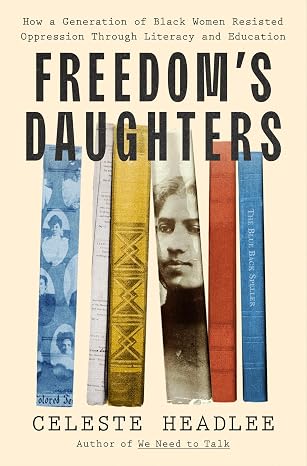
Freedom’s Daughters by Celeste Headlee
Sometimes history changes because someone gives a speech. Sometimes it changes because someone teaches another person to read. Freedom’s Daughters is interested in that second kind of power. Celeste Headlee begins with gaps in her own family history and uncovers generations of Black women who treated literacy and education not simply as opportunities for individual advancement, but as tools of resistance. At the center is her great-grandmother Carrie Still Shepperson, who was born into slavery and later became an educator and activist. Shepperson belonged to a generation of formerly enslaved people who built schools, created libraries, taught communities, organized for civil rights, and understood that knowledge itself could disrupt systems designed to limit Black freedom. That perspective is what pulls me in. Education can sound neutral when we talk about it from a distance. A school. A book. A lesson. But who is permitted to learn has never been a neutral question. Neither is who gets remembered for creating the institutions that made learning possible.Now this is the historical foundation of the seven books and a reminder that literacy, knowledge, and access to education are not abstract ideas. They can become forms of resistance powerful enough to change what is possible for the generations that follow.
You can get a copy of this book on Amazon.
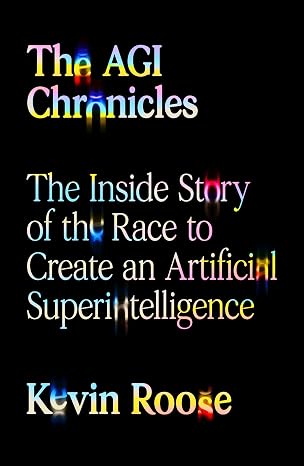
The AGI Chronicles by Kevin Roose
There are very few subjects right now where I feel like the information I understood six months ago may already require an update. Artificial intelligence is one of them. The AGI Chronicles looks at the modern race to develop increasingly powerful AI systems and the people, companies, disagreements, ambitions, fears, and enormous amounts of money surrounding that race. What makes this especially interesting to me is the tension built into the entire subject. Some people working toward artificial general intelligence believe increasingly capable systems could help solve major human problems. Others worry those same systems could become dangerous if they grow more autonomous than their creators know how to control. And somehow everyone is still building them. That is one of those situations where “So what could possibly go wrong?” is less of a joke than I would prefer. The book follows the recent development of AI through laboratories, companies, technical breakthroughs, internal battles, safety debates, and questions about how these systems might eventually be used. I do not need a book about AI to tell me whether I should be optimistic or terrified. I want it to help me understand what we are actually building well enough to ask better questions. This is the most immediately contemporary big-idea book here with technology, intelligence, autonomy, power, safety, control, and the awkward reality that humanity may have started building something before fully agreeing on what should happen if we succeed.
You can get a copy of this book on Amazon.
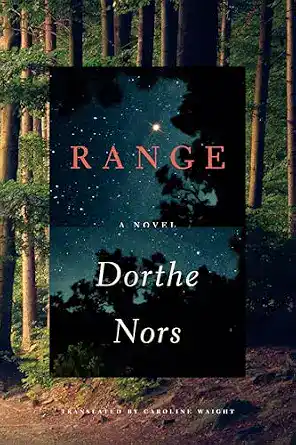
Range by Dorthe Nors, Translated by Caroline Waight
I love the contradiction at the center of Range. Gunn Haven studies gamma-ray bursts. She thinks about light traveling toward Earth from the oldest galaxies. Her work operates at scales most of us can barely imagine. And yet ordinary human interaction can still completely defeat her. That feels correct somehow. Gunn has stepped away from teaching and moved into a country house left to her by a woman named Magna. The reasons behind both decisions emerge gradually as Gunn walks, works through equations, looks at the night sky, communicates with a colleague, interacts with neighbors, and tries to understand both the people around her and herself. Her instinct is scientific. Observe. Record. Analyze. Conclude. But human beings are deeply inconsiderate about behaving like clean data sets. I am drawn to books that put enormous intellectual questions beside very ordinary experiences. What can we know? How do we know it? What happens when observation does not produce certainty? How can someone understand the physical universe and still struggle with the mystery of another person? This is the consciousness book, the one that takes us outward toward galaxies and then turns the telescope around and asks why understanding ourselves may be the harder scientific problem.
You can get a copy of this book on Amazon
Deeper TBR Bundle: Add These Two
These next two books turn the questions speculative. Instead of explaining the world we already inhabit, they alter something fundamental and see what happens.
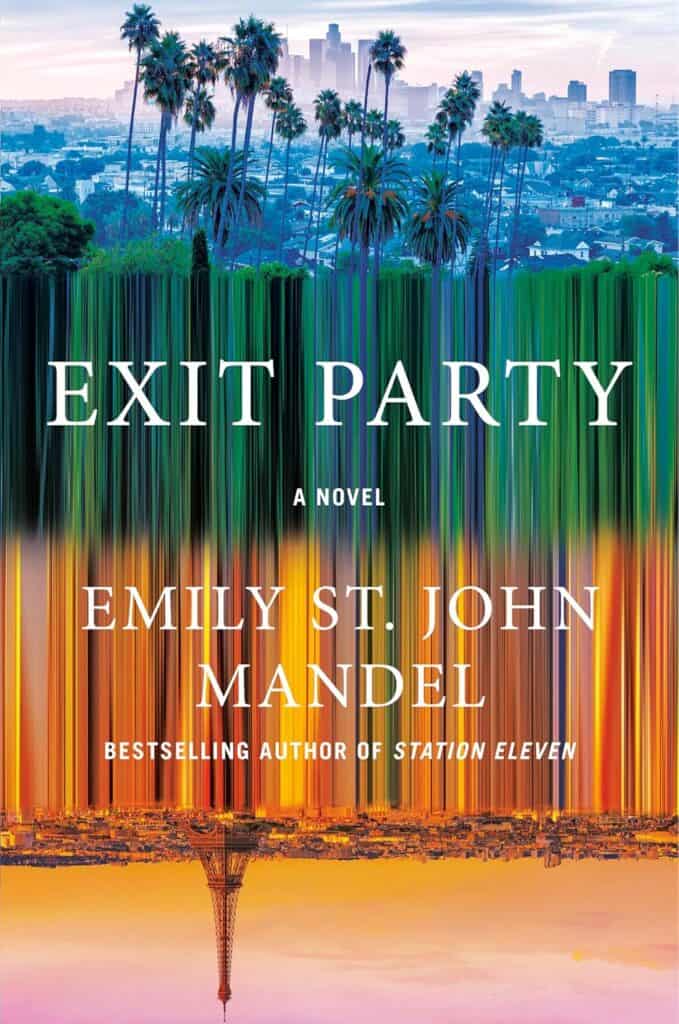
Exit Party by Emily St. John Mandel
This is exactly the kind of speculative premise I love because the weirdness arrives as a question. At a party in Los Angeles in 2031, people disappear. Someone appears to exist in two places at once. An artwork changes hands. And eventually those strange details open into parallel timelines and alternate versions of reality. The story moves across decades and between different possibilities, connecting individual choices with much larger questions about history, political fracture, chaos, control, and identity. What interests me most about parallel-world stories is rarely the mechanics. It is the confrontation. If there is another version of you somewhere, how different could that person become under different circumstances? If history branches, how much of a society’s future comes from inevitability and how much comes from choices? If two worlds respond differently to instability, what do those differences reveal? That is when speculative fiction works best for me. The impossible thing is not there merely because it is cool. The impossible thing gives us another way to examine something very real. This is the parallel-reality thought experiment of identity, history, chaos, authoritarian control, alternate lives, and the unsettling possibility that the distance between two different worlds may begin with surprisingly small choices.
You can get a copy of this book on Amazon.
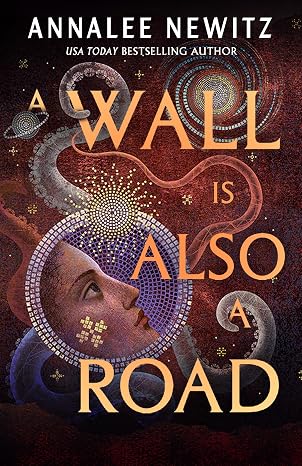
A Wall Is Also a Road by Annalee Newitz
And now, Besties, we need to discuss the slime mold getting a doctorate. Because apparently that is where this reading list is going. Gardenpath is a sentient slime mold who discovers intelligent multicellular life on Earth and decides to make humans the focus of an academic dissertation. Already, I have questions. Gardenpath travels to ancient Pompeii and assumes human form to study the people living there. Naturally, the research gets complicated. There are academic pressures. Ethical problems. An abusive advisor. An emotionally and physically complicated relationship with Murtis, one of Gardenpath’s research subjects. And looming over absolutely everything is the minor historical inconvenience of Mount Vesuvius preparing to erupt. What makes the premise genuinely fascinating is the outside perspective. Human behavior feels normal to us because we are humans. But what if someone else had to study us? Our bodies. Our social systems. Our ethics. Our research practices. Our ideas about love. The arbitrary rules we have all agreed are apparently just how things work. Suddenly the familiar becomes extremely strange. This is the delightfully weird philosophical experiment; it has academia, research ethics, ancient Pompeii, love, disaster, and humanity being observed by someone who has absolutely no reason to assume our behavior makes sense.
You can get a copy of this book on Amazon.
Full Immersion Bundle: Add These Final Two
The final two books go after two structures we usually take for granted. Stories. And society. Which feels appropriately ambitious for the seven-book version.
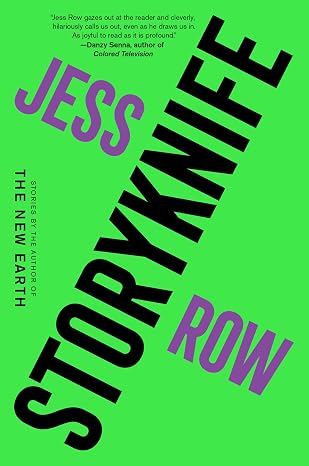
Storyknife by Jess Row
Storyknife is the book in this bundle that looks at the story you are reading and says: You know I made all this up, right? And then somehow keeps making you care anyway. These stories play with narrative conventions, literary theory, narrators, fictional characters, reader expectations, and the strange agreement we enter every time we open fiction. We know these people are invented. We know the author is deciding what information to reveal. We know scenes are constructed. We know narratives manipulate attention. We know stories turn enormous lives into beginnings, middles, and endings. And we continue reading them. Why? That question fascinates me. Humans tell stories constantly. Books. Family histories. News. Gossip. Memory. The explanation we give ourselves for why we made a decision. Even our identities become narratives assembled from selected moments. Storyknife seems interested in pulling apart that machinery without pretending we can somehow stop using it. This is the metafiction pick, the book for readers who want to think about why stories work, how they manipulate us, where their conventions come from, and why we remain helplessly dependent on narrative even when we can see every seam.
You can get a copy of this book on Amazon.
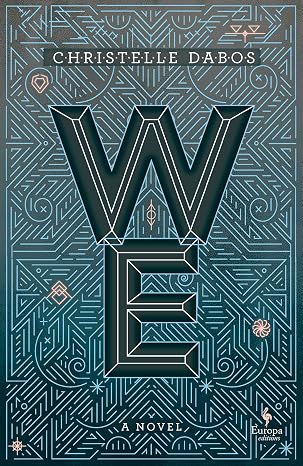
We by Christelle Dabos, Translated by Hildegarde Serle
We takes one of the oldest questions in dystopian fiction and makes it feel deeply unsettling: What happens when a society decides it knows exactly what you are for? Citizens in this world are governed by biological Instincts that determine vocation, social value, behavior, and moral expectations. From childhood, people learn to understand themselves as part of the collective We. Individuality is not exactly encouraged. Then students begin disappearing. Contradictions inside the system start surfacing. And characters positioned differently within the social order begin seeing cracks in the idea that everyone has a natural place and should simply be happy to occupy it. What I find especially interesting here is the promise of a dystopia that does not reduce everything to an easy individualism-good, collectivism-bad equation. The more useful question is how systems persuade people to participate in them. When does belonging become obedience? When does purpose become assignment? When does certainty become control? And if a system tells you that your role is biologically inevitable, what does resistance even look like? This is the society-under-the-microscope book with individuality, collectivism, labor, obedience, belonging, institutional power, and the frightening appeal of a system that promises everyone a clear purpose.
You can get a copy of this book on Amazon.
What Connects These Seven Books?
At first glance, a history of Black women educators and a novel about an academically ambitious slime mold may seem to have very little in common. Fair. But every book in this bundle is interested in systems of understanding. Education. Technology. Science. History. Government. Academia. Literature. The stories societies tell about why things work the way they do.
- Freedom’s Daughters asks us to think about who gets access to knowledge and why that access can threaten power.
- The AGI Chronicles asks what happens when humans begin creating intelligence outside ourselves.
- Range asks how much knowledge can actually tell us about consciousness and identity.
- Exit Party destabilizes reality itself to examine history, order, and chaos.
- A Wall Is Also a Road turns humanity into someone else’s research subject.
- Storyknife takes apart the mechanism of narrative while still using narrative to do it.
- We asks what happens when a society transforms one interpretation of human nature into an entire social order.
Different subjects. Same reading pleasure. Each one takes something that feels familiar and turns it slightly until I am forced to look again.
Want To Save This Post?
Who Should Choose the Big Ideas for Long Nights Bundle?
Choose this mood if your favorite reading experience involves curiosity more than comfort, adrenaline, or escape. It is especially good for readers who love:
- Thought-provoking nonfiction
- Books about AI and technology
- Black history
- Philosophical literary fiction
- Speculative fiction
- Dystopian novels
- Books about consciousness
- Metafiction
- Academia stories
- Social criticism
- Big ethical questions
- Fiction that trusts the reader to think
This is also a good bundle for readers who like moving between genres rather than staying inside one category. You can read history one night, literary fiction the next, then wake up three days later emotionally invested in a sentient slime mold’s academic career. That’s reading with range.
How to Read This Bundle
Start With the Essential 3 If You Want the Core Thinking-Season Experience
Begin with Freedom’s Daughters, The AGI Chronicles, and Range. These books give you history, technology, science, consciousness, race, education, family, and the future of intelligence. The subjects are enormous, but each one approaches them through people rather than abstractions. That is the combination I wanted at the center of this mood.
Expand to 5 If You Want the Questions to Get Stranger
Add Exit Party and A Wall Is Also a Road. Now we move from understanding reality into changing its rules. Parallel timelines let us think differently about history and identity. A nonhuman researcher lets us see humanity from outside ourselves. This is where the bundle becomes wonderfully speculative without giving up the intellectual questions underneath it.
Read All 7 If You Want the Full Rabbit Hole
Add Storyknife and We. Now we are questioning the stories humans tell and the systems humans build. By the end of the seven-book version, almost nothing gets to remain unquestioned. History? We are looking again. Intelligence? Complicated. Reality? Apparently negotiable. Academia? We have concerns. Storytelling? Suspicious. Society? Definitely needs further investigation. Exactly the reading experience I wanted.
The Questions I Would Carry Through This Bundle
Who Gets to Decide What Counts as Knowledge?
This question appears again and again. Institutions decide what gets taught. Researchers decide what gets studied. Historians decide whose lives enter the record. Technology companies decide what information trains their systems. Authors decide what the reader gets to know. Knowledge is never simply sitting there untouched. Someone is always selecting, organizing, interpreting, and distributing it. That is worth noticing.
When Does a Useful System Become a Dangerous One?
Humans love systems. Educational systems. Scientific methods. Technological systems. Social structures. Narratives. Categories. They help us understand complicated things. But the books in this bundle keep asking what happens when the structure designed to help us understand reality starts controlling what we are allowed to see. That is where things get interesting.
What Makes Us Human If Intelligence Isn’t Enough?
I keep coming back to this one. If a machine can become intelligent, is intelligence what makes us distinct? If an alien slime mold can observe human behavior, what does it notice that we cannot? If consciousness remains difficult to explain scientifically, what exactly are we talking about when we say “self”? If societies can shape people into particular kinds of citizens, how much of identity is individual? I do not expect seven books to answer any of this. I would be slightly suspicious if they did.
More From My 2026 Fall Reading Guide
Big Ideas for Long Nights is one of eight mood-based bundles in my complete 2026 Fall Reading Guide. Head back to the full guide to explore all eight fall reading moods and choose the version of the season your brain actually wants. Maybe tonight you need romance. Maybe you need a thriller you will regret starting at 10 p.m. Maybe you need a haunted manor. Maybe you would like to spend your evening contemplating artificial superintelligence, consciousness, Black educational history, parallel realities, research ethics, storytelling, and the philosophical implications of sentient slime mold. There is room for all of us. That is why I love building these reading guides around mood instead of genre. Sometimes “What do I feel like thinking about?” is much more useful than “What category do I feel like reading?”
Final Thoughts
I think curiosity is one of the best reasons to read. Not because every book needs to teach me something. Not because reading has to become homework. And definitely not because I need to emerge from every novel with several academically respectable thoughts. I just love that books let us temporarily borrow another way of looking. A historian can show me where the record went quiet. A technology reporter can take me inside rooms where decisions about the future are being made. A novelist can put me inside the mind of an astrophysicist. Speculative fiction can split reality in two. Science fiction can hand the research project to a slime mold. A short story can show me the scaffolding holding the story itself together. A dystopian novel can take one social assumption and build an entire frightening world around it. Then I close the book. The room comes back. But the idea stays. That is Big Ideas for Long Nights.
So tell me, Besties: are you starting with the 3-book quick mood, expanding into the 5-book deeper TBR, or going all seven and committing your fall reading season to the full intellectual rabbit hole?