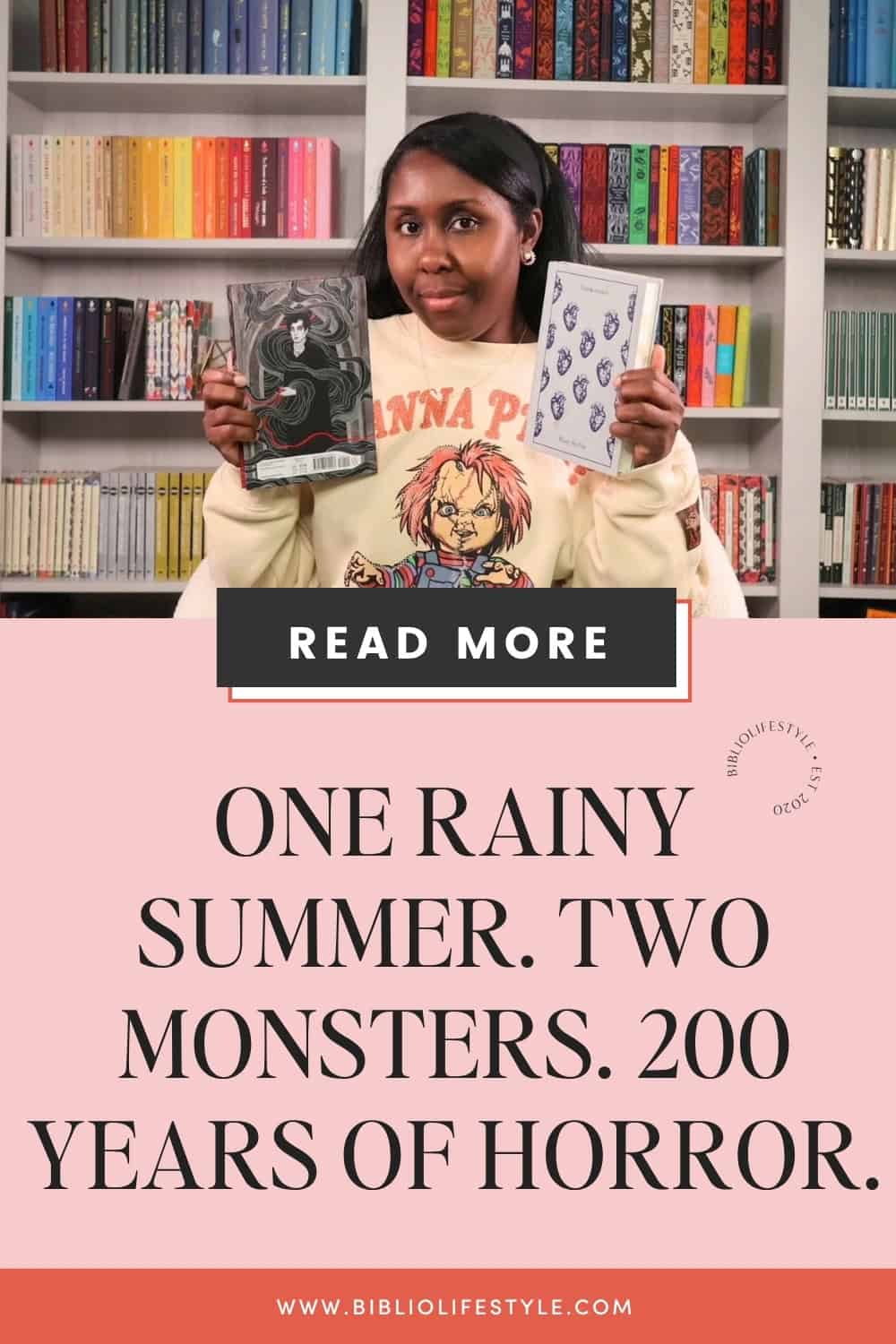
The Haunted Summer of 1816, The Birth of Frankenstein, and The Modern Vampire
Discover how Frankenstein and the vampire emerged from the haunted summer of 1816, when Mary Shelley, John Polidori, and one rainy dare changed horror forever.

The Rainy Summer That Changed What a Monster Could Be
Hi Bookish Besties, Here is the thing almost nobody tells you about two of the most famous monsters in literature: they can be traced back to the same strange gathering, the same ghost-story challenge, and the same wet, miserable summer beside Lake Geneva. The thing that set everything in motion wasn’t a mad scientist hunched over a body or a count waiting in a Transylvanian castle. It was a volcano on the other side of the planet. So pour yourself something warm, because this is quite the story. It has everything I want from literary history: unprecedented weather, a scandalous house party, famous poets behaving badly, an eighteen-year-old woman nobody would have expected to win the room, professional resentment so intense that it helped reshape the vampire, and two monsters that simply refused to die.
So if somebody tells me classic literature is boring, this is the story I want to give them. Because this does not begin with respectable people quietly discussing “important literature.” It begins with a natural disaster, moves into what may be one of the messiest house parties in literary history, and eventually reaches everything from Jurassic Park and rogue-AI stories to Lestat lounging around New Orleans. But the part that fascinates me most isn’t simply that Frankenstein by Mary Shelley and the modern literary vampire share an origin story. My thesis is bigger than that. I think the summer of 1816 helped change what a monster could be.
Mary Shelley gave us horror born from human creation, ambition, abandonment, and the terrible question of what happens when our ability to make something outpaces our willingness to take responsibility for it. John Polidori helped transform the vampire from the grotesque undead creature of folklore into someone elegant, socially powerful, charismatic, and dangerous enough that you might willingly let him through the door. One monster asked us to fear what we might create, the other taught us that the monster might already be sitting beside us looking perfectly charming, and both walked out of the same haunted summer.

The Story Actually Begins With a Volcano
Before we get to Mary Shelley, Lord Byron, or Villa Diodati, we have to travel thousands of miles away from Switzerland. In April 1815, Mount Tambora erupted on the Indonesian island of Sumbawa in one of the largest volcanic eruptions in recorded history. The eruption sent enormous amounts of material into the atmosphere, and its climatic effects helped cool temperatures and disrupt weather patterns far beyond the region where the eruption itself occurred. The following year became known as the Year Without a Summer, which is already such a wonderfully gothic name that it sounds less like a historical event and more like something I would immediately pick up from a bookstore display. But this was real and the reality was devastating.
Across parts of Europe and North America, people experienced abnormal cold, relentless rain, frost during months when there should have been warmth, crop failures, rising food prices, hunger, and unrest. People suffering beneath those strange skies had no way of knowing that an eruption thousands of miles away had helped disrupt the weather around them. And this is where literary history starts doing that thing I love, where the larger world and the private act of writing suddenly collide. Because while ordinary people were dealing with the very real consequences of a damaged growing season, a small group of writers had gathered beside Lake Geneva, and then the rain kept coming.
Villa Diodati Had the Messiest Guest List Imaginable
Lord Byron had rented Villa Diodati, a large house overlooking Lake Geneva, during the summer of 1816. The people moving between Byron’s villa and the nearby house where Mary Godwin, Percy Bysshe Shelley, and Claire Clairmont were staying make this story sound less like the birth of literary history and more like the opening episode of an extremely expensive period drama.
There was Byron himself, already one of Europe’s biggest literary celebrities and nearly as famous for his scandals as his poetry. He had left England under a cloud of gossip, debt, public fascination, and controversy. Then there was Percy Bysshe Shelley, another radical young poet, traveling with Mary Godwin. Mary was only eighteen, and their relationship had already caused enormous scandal. Percy was still married when he and Mary had originally left England together. Mary’s stepsister Claire Clairmont was there too. Claire had been involved with Byron and was pregnant with his child. Then there was John William Polidori, Byron’s young physician, who had the truly unenviable position of traveling with one of the most famous, charismatic, and difficult men in Europe.
I cannot overstate how much I would watch this television series. Give me eight episodes, beautiful Swiss scenery, terrible weather, interpersonal disasters, and one entire installment devoted to everybody silently resenting Byron at dinner. Instead, they got the summer of 1816. The cold and rain repeatedly kept the group indoors, which meant they had plenty of time to talk. And when a collection of Romantic writers spends too much time trapped inside during sinister weather, apparently the natural result is a conversation about ghosts, death, science, and whether the dead might somehow be brought back to life. Normal vacation activities.
Then Came the Ghost-Story Dare
During those gloomy evenings, the group read supernatural stories, including tales from Fantasmagoriana, a French collection of German ghost stories. Eventually, Byron proposed that everyone write a ghost story of their own. That challenge has become one of the most famous writing prompts in literary history. What I love about this part is knowing what happens next while imagining how unremarkable the moment probably seemed at the time. Nobody stood up and announced that they were about to permanently alter horror fiction. They were bored, the weather was dreadful, they’d been reading scary stories, and somebody suggested they make up their own. That’s it. History rarely knows when it’s being history. Byron began a supernatural tale but never completed it. Percy Shelley apparently didn’t produce anything enduring from the challenge either. Mary struggled at first. She later wrote about the frustration of being asked whether she had thought of a story and having to admit that she had not. I find that detail strangely comforting. One of the most influential novels ever written began with its author essentially saying, “Nope. Still nothing.” Then one night, after conversations that had included experiments, the principle of life, and the possibility of reanimating dead matter, something changed. Mary went to bed, and somewhere between waking and sleep, she saw an image.
Mary Shelley Saw a Student Kneeling Beside the Thing He Made
Mary later described imagining a pale student of forbidden arts beside the body he had assembled, watching as the creature began to show signs of life. That image became the seed of Frankenstein. And this is the moment in the story that gets me every single time. Mary had been asked to write a ghost story. She didn’t really give them one; instead, she gave them something much more modern. She imagined a human being who uses knowledge to cross a boundary, succeeds at doing the impossible, and then immediately discovers that success has consequences he never bothered to consider. The frightening thing isn’t simply that Victor Frankenstein creates life. The frightening thing is that he wants the achievement without accepting responsibility for what he creates. That distinction is why I don’t think Frankenstein has ever stopped being relevant. Victor’s great question is, essentially, “Can I do this?” Mary’s novel keeps asking the question he should have considered first: And what happens if you can?
Monster Number One: Frankenstein Made Human Progress Frightening
Frankenstein; or, The Modern Prometheus was published anonymously in 1818, when Mary Shelley was twenty years old. The original edition did not have her name on the title page, and Percy Shelley wrote the preface, which contributed to assumptions that a man had written the novel. Mary’s name appeared on the 1823 edition. That detail still irritates me every time I think about it. An eighteen-year-old woman begins writing one of the most influential novels in literary history, publishes it at twenty, helps establish an entirely new way of imagining speculative fiction, and at first, readers aren’t even clearly told that she wrote it. And what she wrote wasn’t merely a successful Gothic novel.
Frankenstein is often described as a foundational work of modern science fiction because the source of its horror is not simply a ghost, demon, curse, or supernatural creature. The catastrophe comes from human experimentation and our attempt to use science to do something previously believed to be impossible. That idea has never left us. Every time I watch or read a story about scientists cloning something they absolutely should not have cloned, engineers creating an intelligence they can no longer control, corporations developing technology before considering the ethical consequences, or researchers standing around a destroyed laboratory looking shocked that their extremely questionable experiment went badly, I can hear Mary Shelley in the background. Two hundred years later, we are still telling stories built around the same anxious question. What happens when human beings become capable of creating something before they’ve become wise enough to deal with it? This is why reducing Frankenstein to a Halloween monster has always felt like such a loss to me. The Creature isn’t the only monster Mary gave us; she gave us the irresponsible creator, and I think that figure may be even harder to kill.
Why I Don’t Believe Frankenstein Was a Lucky Teenage Fluke
There is a version of Mary Shelley’s story that I don’t particularly like. It goes something like this: a bunch of famous writers were stuck inside, Byron suggested a competition, an eighteen-year-old girl had a spooky dream, and, what incredible luck, she accidentally wrote Frankenstein. I think that’s completely backwards. The challenge mattered, the weather mattered, the conversations happening around her mattered, and the nightmare obviously mattered. But Mary Shelley did not walk into Villa Diodati as an empty vessel waiting for brilliant men to give her an idea. She arrived with a mind and a history of her own. Her mother was Mary Wollstonecraft, the groundbreaking writer and feminist thinker best known for A Vindication of the Rights of Woman. Wollstonecraft died from complications following Mary’s birth. Mary was only eleven days old. So from the beginning of Mary’s life, creation and death were painfully entangled.
By the time Mary reached Geneva in 1816, she had also experienced motherhood and loss herself. In 1815, she had given birth prematurely to a daughter who died shortly afterward. In her journal after the baby’s death, Mary recorded a dream in which her child came back to life after being warmed by the fire. I don’t think we need to turn Frankenstein into a one-to-one autobiography to see why this matters. Mary’s imagination had already spent time in the territory the novel would explore: birth, death, creation, grief, responsibility, abandonment, and the terrifying fragility of life. Later, tragedy would continue to follow her; sadly, she would lose more children. Percy Shelley would drown in 1822, leaving Mary widowed at twenty-four. But those later losses aren’t why an eighteen-year-old Mary conceived Frankenstein in 1816. I think they remind us, instead, how consistently questions of life, death, grief, and survival ran through the world she inhabited. The ghost-story contest gave Mary a doorway; she was the person who knew how to walk through it.
Frankenstein’s Creature Is Sadder Than Pop Culture Lets Him Be
This is also why I always want people who only know “Frankenstein” from Halloween decorations to read the actual novel. Mary’s Creature is not the flat-headed green figure we’ve inherited from later films and popular culture. He thinks, speaks, observes, learns, reads, and he desperately wants companionship. He is capable of tenderness before he is capable of vengeance, and the first person who should care for him, his own creator, looks at him and runs. That changes how I read the entire novel. To me, the most heartbreaking question in Frankenstein isn’t whether Victor should have created life. It’s what he owed that life once he created it. The Creature is terrifying, yes, and he also becomes violent. Mary doesn’t let him remain innocent forever, but she refuses to make him simple.
The Creature wants to be seen as something other than the appearance people recoil from, and every rejection pushes him further toward becoming exactly what everyone already believes he is. For all the graveyards, laboratories, storms, and gothic atmosphere in this book, its emotional center feels painfully ordinary. What happens to someone who wants to belong and is repeatedly told there is no place for him? That’s one reason I think Frankenstein survives every new generation. So while technology changes, loneliness doesn’t.
Meanwhile, Another Monster Was Taking Shape
If Frankenstein had been the only important work to emerge from the summer of 1816, this would already be one of the greatest literary origin stories ever. But remember: there was another unfinished story in the room. Byron had begun a tale involving a mysterious aristocratic traveler named Augustus Darvell. He eventually abandoned it, leaving behind what became known as his “Fragment.” John Polidori took the broader idea in another direction and the result was “The Vampyre,” published in 1819. And this is where I need to make an important distinction, because Polidori did not invent vampires. People had been telling stories about revenants and the blood-drinking or life-draining dead for centuries. What Polidori helped invent was something much closer to the vampire we still recognize in modern popular culture, and that change was enormous.
Monster Number Two: Polidori Let the Vampire Into the Drawing Room
The vampires of European folklore were not necessarily creatures you were expected to find attractive. They were often imagined as disturbing corpses associated with graves, disease, death, and decay. They belonged to the frightening world of the dead returning when they should have stayed buried. Then Polidori gives us Lord Ruthven. Ruthven is aristocratic, wealthy, mysterious, socially powerful, fascinating, and he can move through polite society rather than shuffling out of a grave in a dirty burial shroud. So suddenly the vampire isn’t frightening because you can immediately recognize him as a monster; actually, he’s frightening because you can’t. That, to me, is the genius of the change. This monster can be invited to dinner, he can have money, be interesting, seductive, and make everyone else in the room want to know him. Polidori helped move the vampire out of the graveyard and into society. And once he did that, the vampire’s entire future opened up.
Lord Ruthven Was Also an Extremely Petty Portrait of Lord Byron
Now we arrive at one of my favorite pieces of this story. Because who does Polidori’s charismatic, dangerous, aristocratic vampire resemble? Lord Byron. Polidori had an uneasy relationship with his famous employer, and the Byronic quality of Lord Ruthven was not particularly difficult for contemporary readers to recognize. Even the name Ruthven had already been connected to Byron through Lady Caroline Lamb’s novel Glenarvon, which featured a character widely read as a fictionalized attack on Byron. So yes, there is a completely respectable literary discussion to be had here about Romanticism, aristocratic corruption, social power, sexuality, and the evolution of gothic fiction. There is also a version that goes: John Polidori found his boss so exhausting that he helped turn him into the prototype for the seductive modern vampire. Both things can be true. And I’m sorry, but the second version is why I will happily tell this story to anyone who stands near me long enough in October. It somehow gets better.
Then Byron Got Credit for Polidori’s Vampire
When The Vampyre appeared in The New Monthly Magazine in April 1819, it was published under circumstances that caused readers to associate the story with Byron rather than Polidori. Byron publicly denied writing it. Polidori tried to establish his authorship and explain that although Byron’s abandoned fragment had helped inspire the idea, The Vampyre was his work. But Byron’s name was Byron’s name, and it sold. What I find it fascinating is that both major literary monsters connected with the summer of 1816 entered the world with complicated questions of public authorship hovering around them. Mary’s Frankenstein appeared anonymously, and Polidori’s The Vampyre appeared attached to the name of the vastly more famous man he had been traveling with. Two young writers created works that would influence generations of storytelling, while celebrity and assumption initially threatened to obscure who had actually done the writing. Literary history, Besties, can be incredibly rude.
This Is Where My Thesis Really Starts
The reason I’m obsessed with connecting these two stories isn’t simply because saying “Frankenstein and the vampire were born from the same challenge” is excellent trivia. It’s because I think the two works changed horror in almost opposite directions. Mary Shelley looked at human intelligence, experimentation, and ambition and found the monster we could make ourselves. Polidori looked at charisma, status, beauty, and social power and found the monster we might willingly trust.
Victor creates something whose outward appearance terrifies everyone, but who begins his life longing for kindness and companionship. Lord Ruthven looks like he belongs among civilized people while behaving as a predator. Do you see why I can’t leave this alone? One monster looks monstrous and wants desperately to be treated as human. The other looks perfectly human and is monstrous. One comes from humanity pushing too far into the future. The other is already moving comfortably through the drawing room. Together, they anticipate two enormous branches of the horror stories we’re still telling. What happens when we create something we cannot control? And: What happens when evil doesn’t look like evil? Those questions still work, and they work perhaps too well.
The Vampire Walked Out of Switzerland and Kept Changing
This is where the story becomes one of my favorite kinds of literary history: watching an idea travel. Polidori’s Lord Ruthven did not give us every characteristic we associate with vampires today. The vampire continued changing as writers borrowed from folklore, borrowed from one another, discarded old rules, invented new ones, and adjusted the monster to fit whatever frightened, or fascinated, their own generation.
From Lord Ruthven to Varney
By the 1840s, Varney the Vampire was bringing the vampire into sprawling serialized popular fiction. This matters to me because the vampire was no longer confined to one influential literary story. He was becoming mass entertainment. The monster was learning how to sell.
Want To Save This Post?
Then Carmilla Made the Vampire More Intimate
Sheridan Le Fanu’s Carmilla, published in the early 1870s, gave literature one of its most important female vampires decades before Dracula. Carmilla is intimate, sensual, disturbing, and deeply concerned with desire. It brings the vampire closer still, making the threat not simply somebody stalking you from the darkness but somebody invited into your private world. I think that matters enormously to the vampire’s evolution. The closer the monster gets, the more interesting the monster becomes.
Dracula Made the Vampire Immortal in Popular Culture
Then, in 1897, Bram Stoker published Dracula, and this is where the vampire most people recognize begins to solidify. Stoker drew from earlier vampire traditions and folklore, but Dracula became the cultural giant. Count Dracula is now so firmly attached to the idea of the vampire that it’s easy to forget an entire literary lineage existed before he arrived. But Dracula did not walk onto an empty stage, Lord Ruthven had already been there, so was Carmilla and Varney. The vampire had been evolving for most of the nineteenth century before Dracula became its most famous face.
Then Anne Rice Let the Vampire Tell His Own Story
Then we eventually reach New Orleans. In 1976, Anne Rice published Interview with the Vampire, and for me, this is another major turn. The vampire is no longer simply the creature humans hunt, fear, or attempt to understand from the outside. Now he gets to speak, gets interiority, remembers, regrets, wants, suffers and can be monstrous and sympathetic at the same time. That shift opens the door for so much of what comes later: the beautiful immortal, the tragic immortal, the vampire as romantic lead, antihero, tortured protagonist, and object of desire.
Eventually we get Lestat, the Cullens, True Blood, and an enormous amount of fiction populated by immortals with excellent cheekbones and emotional problems spanning several centuries. And somewhere, very far back in that family tree, is John Polidori looking at Lord Byron and apparently deciding, Yes, but what if he were literally a vampire? I love literature.
Frankenstein Traveled Just as Far
Mary’s monster underwent his own strange journey through popular culture. Most people now know a visual version of Frankenstein’s Creature that owes more to twentieth-century film than to Mary’s novel. The green skin, flat head, neck bolts, stiff movement, and laboratory imagery became so culturally powerful that they nearly swallowed the original character whole. Even the name changed in popular understanding, Frankenstein is Victor, The Creature is never actually named Frankenstein in the novel. Yet if I put a picture of the Creature in front of most people and ask who it is, they’re going to say “Frankenstein.” I’m not going to fight everyone at Halloween over it, I am simply going to be quietly bookish and correct in the corner. But the fact that Mary’s creation could change that dramatically and still remain recognizable tells us something about its power. Every generation keeps remaking Frankenstein because every generation keeps finding new things we’re afraid we’ve created. So while the laboratory changes, the anxiety doesn’t.
Even the Weather Feels Like Part of Frankenstein
The Year Without a Summer can make this whole story sound almost too perfectly gothic. The darkness, rain, cold, and the people trapped inside telling supernatural stories. But I don’t want to turn real suffering into spooky literary atmosphere. The climate disruption connected to Tambora contributed to failed harvests, hunger, rising food prices, migration, and serious hardship. What felt like eerie weather to wealthy travelers around Lake Geneva could mean catastrophe to families depending on crops elsewhere. That larger context has changed how I think about Frankenstein. I don’t mean that Mary sat down and secretly wrote a straightforward climate novel. She didn’t. But books absorb the worlds in which they’re made. Once I learned more about 1816, I started noticing how much Frankenstein cares about hostile landscapes, exposure, hunger, isolation, displacement, and a Creature moving through a world in which there seems to be no safe place for him. The weather didn’t write Frankenstein, but I do think some of that broken summer got inside the book.
The Summer of 1816 Didn’t Invent Monsters. It Reinvented Them.
This is ultimately the argument I want to make. Monsters obviously existed before Mary Shelley and John Polidori sat around Lake Geneva. Ghosts existed, vampires existed, revenants existed. So did demons, witches, creatures, supernatural predators, and stories about the dead refusing to stay dead existed long before 1816. But something fascinating happens with the monsters that emerge from Villa Diodati. They move closer to us. Mary gives us a monster born from human intelligence and human failure. We make him. Polidori helps give us a monster capable of moving through civilized society undetected. We welcome him, and that is a very modern kind of fear.
Maybe the monster isn’t waiting outside the village walls. Maybe the monster is the consequence of our own brilliant idea. Maybe he’s sitting at the dinner table. Maybe everyone likes him. Maybe he looks less monstrous than the person we’ve already decided to fear. Maybe the monster is us. That is why I think this rainy summer matters far beyond a fun fact about two gothic stories. The monster changed, and we’re still living with the versions that came next.
Why I Keep Coming Back to Mary Shelley
Mary Shelley died on February 1, 1851, which means 2026 marks 175 years since her death and 210 years since that summer at Lake Geneva.
Her monster is still walking. I don’t say that because I think Mary’s youth is the most interesting thing about her achievement. In fact, I think we sometimes focus on “she was only eighteen!” so much that we accidentally turn her into a literary miracle instead of taking her intellectual accomplishment seriously. Yes, eighteen is astonishing, but what amazes me more is that Frankenstein still holds up under the weight of everything we keep asking it to carry.
- We read it through science.
- Technology.
- Artificial intelligence.
- Motherhood.
- Creation.
- Grief.
- Abandonment.
- Prejudice.
- Responsibility.
- Loneliness.
- Nature.
- Ethics.
- The relationship between a creator and what they create.
- The relationship between society and the people it decides are monstrous.
I can read it at one age and think the Creature is the center of the story, then return later and become obsessed with Victor’s failure of responsibility, then come back again and notice something entirely different. That’s not a teenage fluke, that’s a novel with an extraordinarily long fuse, and two hundred years later, we’re still standing inside the explosion.
Read Frankenstein This October or Anytime Really
So yes, this is me making my case for putting Frankenstein on your October reading list. If the only Frankenstein you know is the flat-headed green guy currently appearing on mugs, porch signs, cookies, pajamas, and approximately seventeen items in the seasonal section, please meet Mary’s version. The actual novel is sadder than I expected the first time I encountered it. It’s stranger, more philosophical, and much more interested in loneliness and responsibility than the pop-culture version prepares you for. And I think knowing the story behind its creation makes the reading experience even richer. A volcano erupts thousands of miles away, the climate changes ,summer fails, and a collection of complicated young writers ends up beside a Swiss lake. The weather drives them indoors, and somebody suggests writing ghost stories. An eighteen-year-old woman can’t think of anything, then she closes her eyes, she sees a student kneeling beside the thing he has made, and literature changes. In the same strange summer, John Polidori takes another idea circling that group and helps turn the folkloric vampire into a beautiful aristocratic predator who can move through society. One monster teaches us to fear what we create, the other teaches us that the monster might be charming, and neither one ever really went away.
Final Thoughts
This is why the summer of 1816 is one of my favorite stories in all of literature. Not because I think one rainy night magically invented horror; it didn’t. And not because Mary Shelley and John Polidori single-handedly invented everything we now associate with Frankenstein’s Creature or the vampire. Literary history is much messier and much more interesting than that. I love this story because you can stand in one moment and see two enormous branches of modern horror beginning to grow and it happened because of the weather, the sky changing, someone suggesting telling ghost stories, and then the monsters come out.
Thank You (My Sources)
- Susannah Fullerton, Lord Byron Proposes a Literary Challenge
- The Public Domain Review, Frankenstein, the Baroness, and the Climate Refugees of 1816
- National Geographic, The Birth of Frankenstein and Mary Shelley’s Famous Summer
- Washington University in St. Louis, 200 Years Later, The Vampyre Still Thrills
- HISTORY, Frankenstein Is Published
- The Conversation, The Vampire’s Rebirth From Monstrous Corpse to Byronic Seducer
- The Gothic Library, The Vampire Literary Canon
- Poetry Foundation, Mary Wollstonecraft Shelley
- Library of Congress, Frankenstein; or, The Modern Prometheus
- Saylor University, Darkness by Lord Byron